The biggest wins come from five habits: set a moderate temperature, keep the filter clean, use Heat mode (not Auto), avoid big on-off swings, and stop heat escaping from the room. None of them costs much, and together they can noticeably lower your winter power bill. Below we explain each one in plain language, what it is worth according to New Zealand’s energy agency, and where a heat pump’s limits lie.
TL;DR
- Aim for 18°C to 21°C. EECA puts the saving at about $40 a year compared with higher settings.
- Clean the filter monthly in winter. EECA estimates this saves about $50 a year.
- Use Heat mode rather than Auto, point the airflow down, and keep the fan on Auto.
- Insulation and draught-proofing matter as much as the heat pump itself.
- A heat pump’s efficiency changes with the weather. Your real running cost will differ from the number on the box.
Table of Contents
- What “efficient” means for a heat pump
- Set the temperature in the 18°C to 21°C range
- Clean the filter every month in winter
- Use Heat mode, not Auto
- Get the fan and airflow right
- Steady beats stop-start, but don’t heat empty rooms
- Keep the heat in: insulation and draughts
- Right size, right place: choosing or checking your unit
- If you rent
- What it costs to run, and why numbers vary
- Where a Power-Saving Box fits in
- Plug-in help for the rest of the house
- A winter checklist you can print
- FAQ
- Sources
What “efficient” means for a heat pump
A heat pump moves heat from outdoor air into your room rather than making heat from electricity directly. That is why it can deliver several units of heat for each unit of electricity, something a plain element heater cannot do. Heat pumps have been common in New Zealand for some time: around 38% of homes had one by 2015, according to BRANZ.
You will see a number called the Coefficient of Performance (COP). Think of it as heat out divided by electricity in. It is easy to treat it as a fixed score, but it isn’t. It is a laboratory rating at set temperatures. BRANZ and EECA’s installation guide both make the point that real-world performance varies. The same unit works harder, and is less efficient, when it heats a cold room on a frosty morning than when it holds a steady temperature on a mild day. In colder parts of the central North Island and the South Island, efficiency drops further as the outdoor temperature falls.
The practical lesson: you can’t change the weather, but you can change how hard you ask the unit to work.
Set the temperature in the 18°C to 21°C range
It is tempting to crank the dial to 25°C to warm up faster. A heat pump doesn’t heat faster at a higher setting. It just keeps running harder for longer once the room reaches a comfortable level.
EECA recommends 18°C to 21°C, which balances comfort, moisture control and cost. It estimates that staying in this range saves about $40 a year compared with higher settings.
A few ways to make it work in real life:
- Pick a temperature, then leave it alone for a few days. Constant fiddling with the remote causes the unit to chase the target.
- If a room feels cold at 20°C, check for draughts and cold surfaces before you turn it up. A cold window or an uninsulated wall makes a room feel cooler than the thermostat says.
- Wear a layer. One extra jumper beats a few degrees on the dial.
The lower range also helps with dampness. EECA ties the 18°C to 21°C range to managing moisture and mould, and BRANZ lists keeping the home well heated and ventilated among the ways to limit the impact of internal moisture.
Clean the filter every month in winter
The filter sits behind the front panel of the indoor unit. When it clogs with dust and pet hair, the unit has to work harder to move air. EECA lists filter cleaning as one of its free winter tips and puts the saving at about $50 a year.
It takes a few minutes:
- Switch the unit off and open the front panel.
- Slide the filters out and vacuum off the loose dust.
- If they are grubby, rinse them gently in lukewarm water, let them dry fully, then refit them.
- Check the outdoor unit while you are at it. Keep leaves, weeds and clutter clear of it so air can flow freely.
EECA compares this to cleaning the filter in a dishwasher or washing machine, and the comparison is a fair one. Put a monthly reminder in your phone from May to September.
A service by a qualified technician is a separate job from filter cleaning. If your unit is making odd noises, smells musty, or leaks water inside, book a technician rather than trying to fix it yourself.
Use Heat mode, not Auto
Many remotes have an Auto mode that switches between heating and cooling by itself. It sounds convenient, but EECA advises choosing Heat or Cool deliberately. In changeable weather, or when another heat source such as a fire is warming the room, Auto can flip between modes and waste energy.
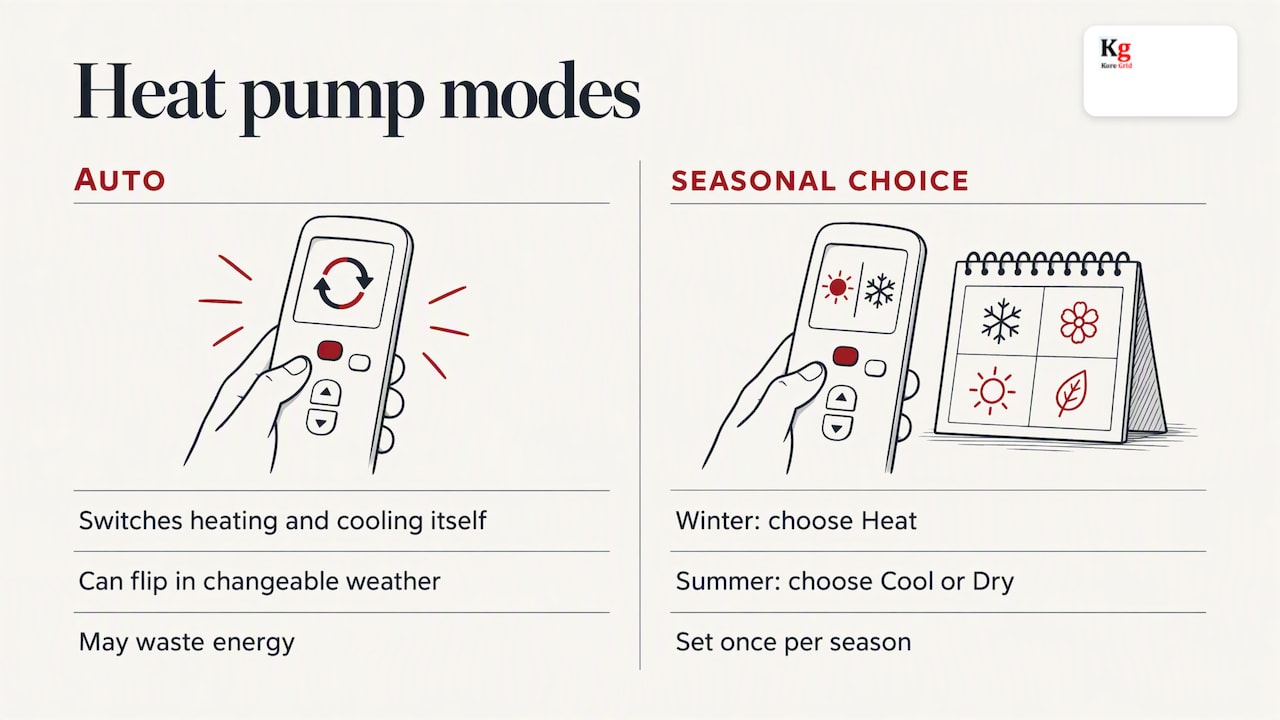
In winter, choose Heat (usually the sun symbol). In summer, choose Cool, or Dry if the air is just muggy. Set it once per season.
Get the fan and airflow right
Warm air rises. If the louvres point straight out, the heat tends to collect near the ceiling while your feet stay cold. The usual advice is to direct airflow downwards in heating mode so the warm air reaches the part of the room you actually sit in. That is one of the habits EECA’s guidance on running your heat pump efficiently covers.
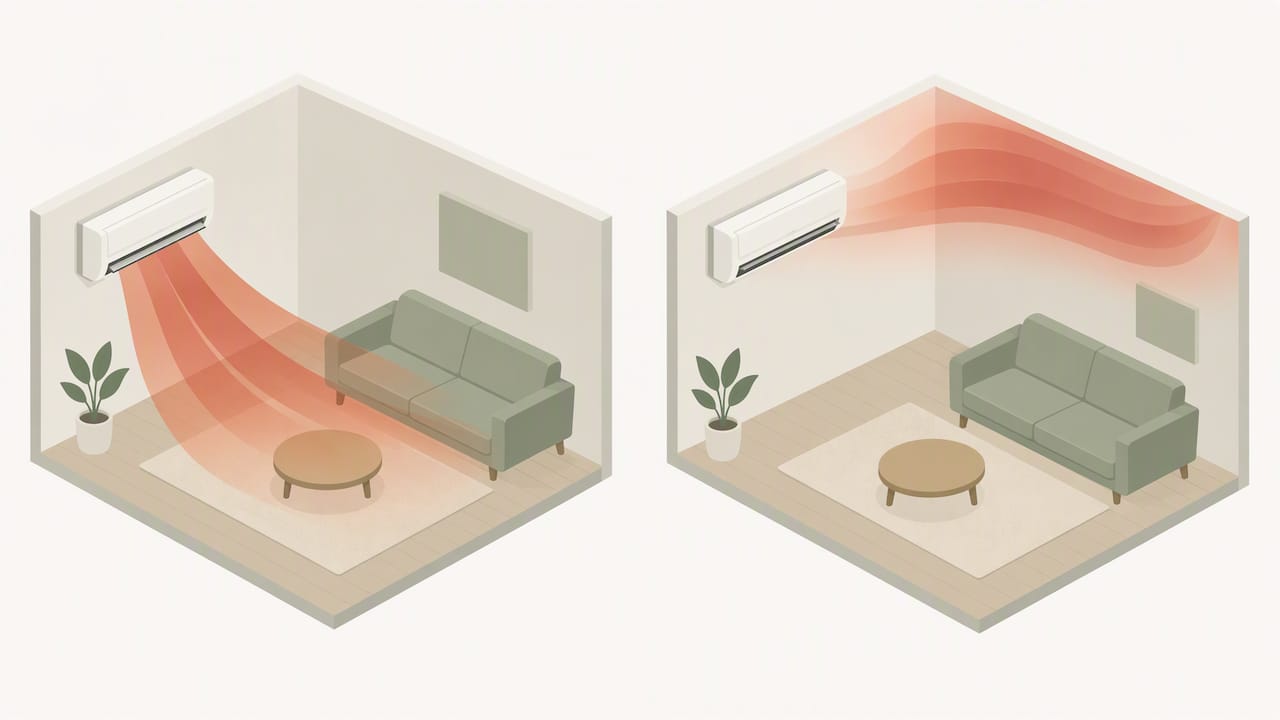
For the fan, leave it on Auto. It can be tempting to force the lowest speed to cut noise or “save power”. But the unit manages its output best when it can choose its own speed, and a forced low setting can leave it working longer to reach the target temperature. If the noise bothers you in a bedroom, look for a quiet or sleep mode on your remote instead.
Placement matters too. Keep furniture and curtains from blocking the indoor unit’s airflow.
Steady beats stop-start, but don’t heat empty rooms
This is where advice gets confusing, so here is the balanced version.
Heat pumps are at their most efficient when they hold a steady temperature. Letting a room go fully cold and then asking the unit to claw back many degrees at full output is the costly pattern. Inverter models, which are the common type now, adjust their compressor speed and are more efficient than fixed-speed units, and they are designed to ease along at low output once the room is warm.
At the same time, the idea that you should run a heat pump 24 hours a day in every case is a myth. EECA’s advice is to heat the space you are using. Warming rooms nobody is in wastes electricity.
A sensible middle path:
- Heat the room you are in, with doors closed to keep the warmth there.
- For an evening in the lounge, switch on a little before you need it at a moderate setting, rather than blasting it at a high setting when you sit down.
- For short breaks, such as a trip to the shops, leave it running or set it back a couple of degrees rather than switching it off completely.
- For days away, switch it off.
Your own bill is the best test. Try one pattern for a couple of weeks, compare it with your power company’s usage graphs, then adjust.
Keep the heat in: insulation and draughts
A good heat pump in a leaky house is like a bucket with holes. EECA and BRANZ both stress that the building itself matters as much as the heater. If you own your home, ceiling and underfloor insulation are the first things to check. EECA’s installation guide is aimed at installers, but its message is clear: design the system around a home that holds its heat.
Easy wins at any budget:
- Draught-stop strips on doors and gaps around windows.
- Thick, lined curtains that reach the floor or sill, closed at dusk.
- Closing doors to rooms you aren’t heating.
- Opening north-facing curtains on sunny winter days so the sun does some of the work.
Right size, right place: choosing or checking your unit
An undersized heat pump runs flat out and still struggles. An oversized one can cycle on and off. If you are buying, or wondering whether the unit you have suits your living room, the EECA installation guide says unit selection should take the local climate into account, including design temperatures, and the room’s size and insulation. Ask the installer how they sized the unit, rather than accepting a rule of thumb.
Position matters as well. The indoor unit should have clear space to throw air across the room, and the outdoor unit needs free airflow and shelter from debris.
If you rent
Renting adds a few twists. Under the Healthy Homes Standards, the main living room of a rental must have qualifying fixed heating with at least a minimum heating capacity worked out from the room’s dimensions and insulation. A heat pump is a common way to meet that. If your landlord has fitted one, you can still apply every habit in this article, since they are all about how you run it.
If your heat pump heats only the lounge, the bedrooms may still be chilly. A small plug-in option can fill the gap without altering the property. For example, a bedroom heater designed for winter use can be a flexible choice for a single room, as long as you use it sparingly and check its power rating first.
What it costs to run, and why numbers vary
People search for heat pump running costs and kWh figures, and it is fair to want a single number. Honestly, no single number is right for every home. Your cost depends on:
- your unit’s efficiency at the outdoor temperature on the day;
- the size and insulation of the space you heat;
- your thermostat setting and how many hours you run it;
- your electricity plan’s price per kWh.
To estimate your own cost, find the unit’s rated power input in kW (on the nameplate or in the manual), multiply by hours of use, then multiply by your plan’s rate per kWh. Treat the result as a ceiling: inverter units usually draw far less than their maximum once the room is warm. Then compare it with your actual bill.
Where a Power-Saving Box fits in
It helps to be clear about what each product does. A power-saving box doesn’t change how a heat pump moves heat, and it isn’t a substitute for any habit above. Those habits are where most of the savings from heating come from.
We build Kore Grid products around one idea: most households lose money on small inefficiencies they can’t see. Heating is the largest and most obvious one, so start with the settings and the house itself. They cost nothing and nobody should skip them. After that, look at the rest of the home’s electricity use. Our Power-Saving Box plugs in, needs no installation, and targets electrical losses and power factor. That makes it a practical fit for renters and for older homeowners who can’t, or don’t want to, take on a big upgrade. We would rather you get the basics right first, and see the box as a helper on top of them.
— Stan Lieder
Plug-in help for the rest of the house
Once your heating habits are sorted, the next step is the rest of your household electricity. The Kore Grid Power-Saving Box is a plug-in unit designed to reduce electrical losses and improve power factor without any installation, so it suits rentals too. If you also want flexible backup power or solar charging, our portable, trolley and stackable storage units are on the products page. Prices are provided on request through our quote process.
A winter checklist you can print
| Task | How often | What to do |
|---|---|---|
| Clean filters | Monthly in winter | Vacuum, rinse if needed, dry fully |
| Check the outdoor unit | Monthly | Clear leaves and clutter |
| Set mode | Each season | Heat in winter, Cool in summer, not Auto |
| Set temperature | Once, then leave | 18°C to 21°C |
| Set fan | Once | Auto |
| Set airflow | Once | Downwards in heating mode |
| Draught check | Before winter | Doors, windows, curtains |
| Technician service | If something seems wrong | Book a qualified technician |
FAQ
What is the best temperature for a heat pump in winter?
EECA recommends 18°C to 21°C. That range keeps most people comfortable, helps manage moisture, and holds the running cost down. If it feels cold at that setting, look for draughts and heat loss before raising the dial.
Is it cheaper to leave a heat pump on all day?
Not always. Heat pumps run best when holding a steady temperature, so avoid letting a room go very cold and then heating it hard. But heating rooms nobody is using wastes power. Heat the spaces you use, keep doors closed, and only switch off for longer absences.
Should I use Auto mode?
We suggest not. EECA advises picking Heat or Cool directly, because Auto can switch between heating and cooling in changeable weather and waste energy. Leave the fan speed on Auto, though.
How much can I save with simple changes?
EECA estimates about $50 a year from monthly filter cleaning and about $40 a year from keeping to 18°C to 21°C. Your own saving depends on your home and how you use the unit. Better insulation and less draughty rooms often add to this.
Do heat pumps lose efficiency when it is very cold?
Yes. BRANZ research shows efficiency falls as outdoor temperature drops, especially in colder regions. Choosing a unit suited to your area’s climate, and keeping your house well insulated, helps offset it.
Leave a Reply