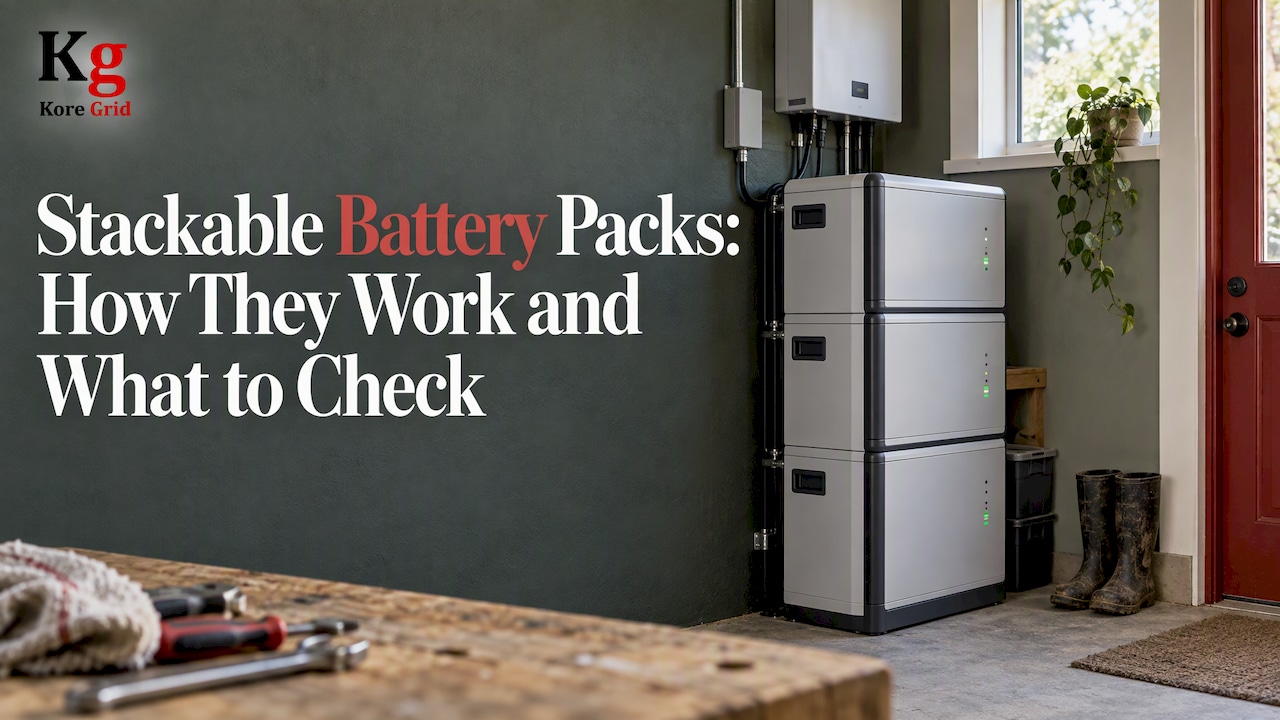
Stackable battery packs are storage units built to connect to one another, so you can start with the capacity you need today and add more later. For a New Zealand home, the useful questions are how much capacity you actually need, how the units are joined, who is allowed to connect them to your house, and what safety rules apply. This guide answers each in plain language.
TL;DR
- A stackable battery is a modular unit that links to others to raise capacity (and sometimes output), so you can start small and expand.
- “Stackable” describes the hardware, not the paperwork. Anything wired into your home’s electrical system in New Zealand needs a licensed electrician and compliance with AS/NZS 5139.
- Size the system around the loads you want to keep running, not around the biggest number on a brochure.
- Batteries are mostly about energy security and using your own solar, not about earning money from exports.
- Daisy chaining only works when the maker designed the units to connect. Never improvise it with mismatched products.
Table of Contents
- What stackable battery packs actually are
- Why modular makes sense for many households
- How much capacity do you need?
- Daisy chaining and running units in parallel
- Safety: what to check on stackable batteries
- What does it cost, and is it worth it?
- Our perspective
- Comparing stackable options by type
- A short buying checklist
- Where our products fit
- FAQ
- Sources
What stackable battery packs actually are
A stackable battery pack is one module in a family of modules. Each module holds a set amount of energy, measured in kilowatt hours (kWh). You add modules to raise the total, much like adding shelves to a bookcase. Some designs sit on a floor stand and clip together vertically. Others sit side by side or on a wheeled trolley.
Three features separate a properly stackable system from a pile of unrelated batteries:
- Matched chemistry and voltage. The modules are designed to work as one bank.
- A management system. Electronics balance charging and discharging across the modules so none is overworked.
- Defined connectors. The maker specifies the cables, ports and the maximum number of modules you can join.
When readers search for a stackable battery system, a stackable home battery or a stackable power station, they mean slightly different scales of the same idea. The scale matters, so here is how we separate them.
Home-scale stacks versus portable stacks
Home-scale stacks are larger units, often mounted on a wall or floor and designed to be part of a permanent setup with solar panels. They are sized in the range of several kWh up to tens of kWh. Portable stackable power stations are smaller and movable. They suit camping, caravans, workshops, and household backup for a few essential appliances.
Both follow the same logic: capacity grows by adding modules. The difference is how they connect to your home, and that difference decides the rules that apply to you.
Why modular makes sense for many households
The main appeal is not having to guess your future. Power use changes. You add a heat pump, an electric vehicle, or a person working from home. A fixed battery is either too small or paid for before you need it. A stackable one lets you buy for the household you have and add capacity when the household changes.
There are other practical reasons:
- Staged spending. You spread the cost across time rather than paying for the largest size at once.
- Easier handling. Smaller modules are lighter than a single large battery, which matters if you are placing them yourself in a garage or utility room.
- Flexibility for renters and movers. A unit you can pick up and take with you is a different proposition from a battery bolted to a wall. Our guide on solar for renters in New Zealand covers what to check before you buy when you do not own the property.
The trade-off is that stackable systems can cost more per kWh than one large unit, and the cap on how many modules you can join is set by the maker. Ask for the maximum, not just the starting size.
How much capacity do you need?
Start with what you want to keep running, then work back to kWh. A rough method:
- List the appliances that matter in an outage: fridge, freezer, lights, router, phone chargers, perhaps a heat pump or a medical device.
- Find each appliance’s wattage on its label and estimate the hours you need it.
- Multiply watts by hours and divide by 1,000 to get kWh. Add them up.
- Check the output rating as well. A battery with plenty of energy but a low output cannot start a power-hungry appliance such as a kettle or a heat pump.
A worked example
Say you want to keep a fridge (about 100 W when running), a few LED lights (30 W), a router (15 W) and phone charging (30 W) going for a 12-hour overnight outage. That is roughly 175 W for 12 hours, or about 2.1 kWh, though a fridge cycles on and off so real use is often lower. Add a margin because batteries are not designed to be run completely flat, and you land at around 3 kWh of usable capacity. A modular system lets you start there and add more if you later decide to include a heat pump.
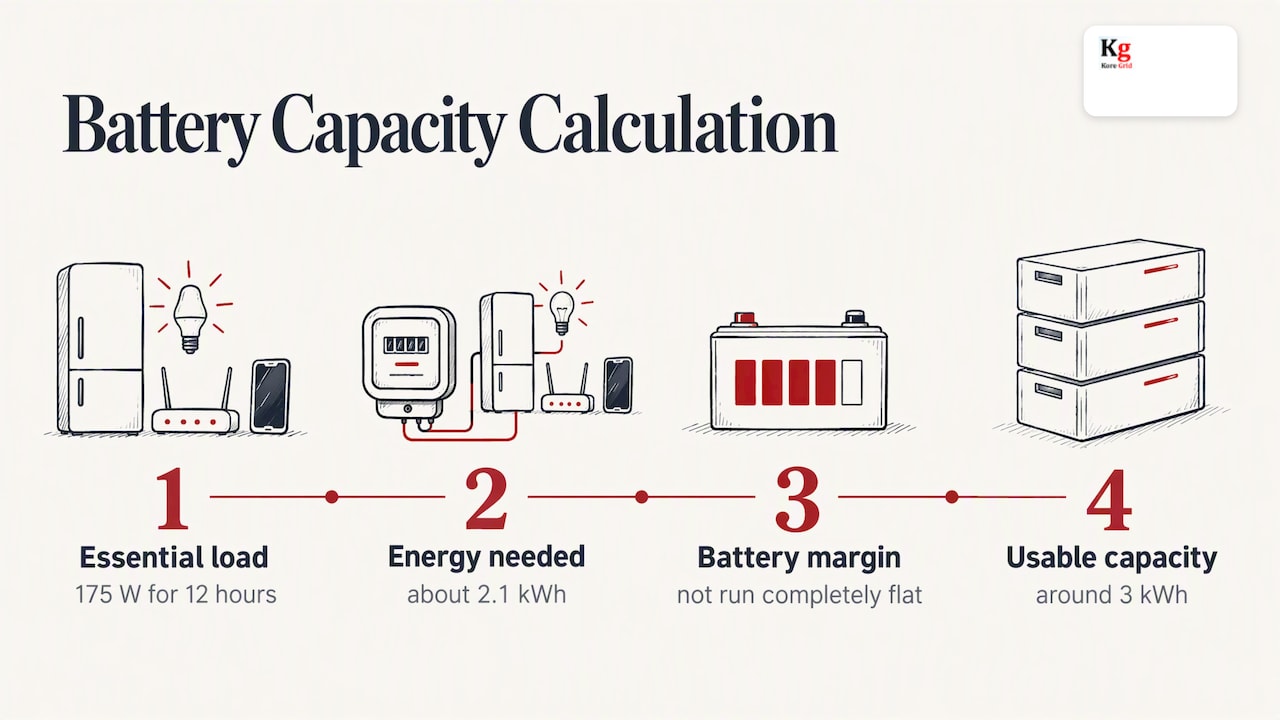
The figures above are an illustration, not a measurement of your home. Check your own appliance labels, or ask us to help you work it out.
Daisy chaining and running units in parallel
Daisy chaining means connecting units one after another so they act as a larger whole. Running in parallel means connecting them side by side so their capacity or output combines. People search for both because they already own one portable power station and want to double it.
The rule is simple: only connect units the maker says can be connected, using the maker’s cables and ports. The reasons are practical:
- Units with different charge levels or different ages can push current between each other when joined.
- Different chemistries and voltages do not share a load safely.
- Without a shared management system, one unit can end up carrying more than its rating.
Some products are built with dedicated expansion ports, and those are the safe route. Others are explicitly not designed to be linked, and the makers say so. Check the manual before you buy a second unit, not after. If the manual does not mention expansion, assume you cannot do it.
Safety: what to check on stackable batteries
Battery safety is mostly about installation, location and heat. Three points matter most.
Installation and the rules in New Zealand
Stackable does not mean DIY. WorkSafe says that battery systems need thought about how and where they are installed, and that some batteries can produce flammable gases, so correct installation practice matters. WorkSafe also warns against DIY solar installations. Plug-in solar and battery kits designed to feed a wall socket are a particular concern for utility workers and fire risk.
For home systems, the relevant standard is AS/NZS 5139. According to Intertek’s summary, it applies to battery systems between 12 V DC and 1500 V DC and up to 200 kWh per system. Draft guidance published for consultation by Standards New Zealand also notes that installations must meet wiring rules and keep clearances from habitable rooms, exits and ventilation openings. That is a draft, so check the final wording with your electrician.
The practical advice: have a licensed electrician connect, commission and sign off any battery that is wired into your switchboard. Ask for the Certificate of Compliance, and tell your insurer.
Location and heat
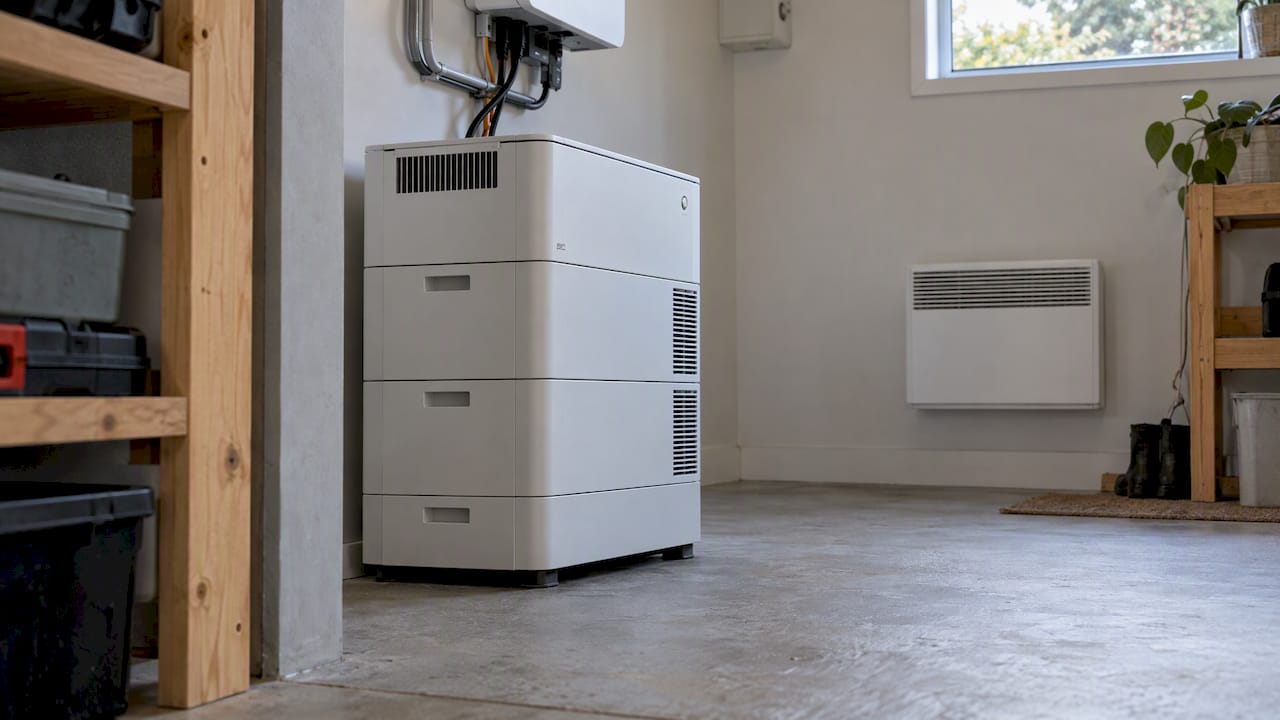
Lithium batteries do not like heat, so keep them out of direct sun, away from heaters, and not in a sealed cupboard or a hot car boot. The same logic applies to small lithium devices, as shown by this guide on storing lithium batteries away from heat. Keep the clearances your installer specifies, and never block vents.
Mixing and matching
Do not mix modules from different families, ages or makers in one stack. If you add a module years later, confirm with the maker that it is still compatible with the units you have.
What does it cost, and is it worth it?
Battery storage is a large purchase. A Solar Scout survey of almost 100 New Zealand systems put an installed battery at $1,249.79 per usable kWh. Use that as a rough guide to the scale of the investment, not a quote. Your price depends on the installer, the site and the product.
The same source’s analysis suggests a battery can lift the internal rate of return on a solar system by 1 to 2 per cent, and that the real value often lies in keeping essentials such as the fridge and lights running during an outage. We agree with that framing. If you are buying a battery purely to make money, the numbers are tight. If you are buying it for resilience and to use more of your own solar, they can make sense.
Don’t count on export rebates
Since 1 April 2026, lines companies have been required to pay rebates for electricity exported at peak times. Newsroom reports that rates range from about 5.24c to 13c per kWh in reported cases, that they apply on weekday peak windows such as 7am to 11am and 5pm to 8pm, and that the money goes to retailers, who are not strictly required to pass it on. Some retailers have declined to pass on the full amount.
So treat any rebate as a bonus, not a payback plan. The stronger saving usually comes from using stored power in your own peak hours rather than selling it. If you want a retailer that shares these incentives, ask directly whether its plan is built for batteries.
Our perspective
We build Kore Grid around one idea: you should be able to improve how your home uses power without a big upgrade or a permanent installation. That is why our range includes a plug-in Power-Saving Box aimed at electrical losses and power factor, and why our energy storage units are portable, trolley-mounted or stackable, each with integrated solar charging.
We see the same misunderstanding often. People hear “stackable” or “plug and play” and assume that means no rules. It does not. The ease is in the hardware, handling and expansion. The electrical connection to a home is a separate matter, and it is where the law and your insurer are involved. We would rather you hear that from us before you buy than after.
Our advice for most households is this. Be honest about what you want to protect. If it is a fridge, lights, a router and some devices, a small modular unit is likely enough, and you can add to it later. If you want to run a heat pump or a whole house, speak to a licensed electrician about the system as a whole before choosing a battery. And whatever you buy, ask for the maximum stack size, the output rating, and what happens to the warranty if you add modules later.
Storage is only half of the picture. Wasting less of the power you already pay for is the other half, and it costs far less. Our page on why power saving matters explains how we think about it.
— Stan Lieder
Comparing stackable options by type
Rather than naming brands, compare by type of product. This table shows how the main formats differ.
| Format | Typical use | Connection to the home | Growth path |
|---|---|---|---|
| Portable stackable unit | Outages, camping, workshops | Appliances plug into the unit | Add compatible modules |
| Trolley-mounted unit | Moving between rooms or jobs | Appliances plug into the unit | Add modules or a second trolley if the maker supports it |
| Wall or floor home stack | Solar storage, whole-home backup | Wired in by a licensed electrician | Add modules up to the maker’s limit |
Our All-in-One Portable, Trolley and Stackable ESS range covers the first two formats and a stackable option, all with integrated solar charging. We do not publish prices for these on the site, so ask us for a quote and we will talk through what suits your use.
A short buying checklist
Before you pay for any stackable battery, get answers to these:
- What is the usable capacity of one module, not just the nominal figure?
- What is the continuous output, and what is the surge output?
- How many modules can be joined, and can you add them later?
- Which cables, ports or accessories are needed?
- Does the maker support adding modules years after the first purchase?
- What is the warranty, and does it change if you expand?
- Who will install and sign it off, if it is wired into the home?
- Is solar charging built in, and what is the maximum panel input?
If a seller cannot answer these clearly, that is information too.
Where our products fit
If you want a simple way to reduce what you pay for electricity without installing anything, start with the Power-Saving Box. It plugs in, so it suits renters and anyone who does not want works done on the house. If your priority is backup and flexible storage, look at our energy storage products and request a quote. We are happy to help you size a setup before you commit.
Thinking about backup more broadly? Our comparison of generator versus battery backup walks through the trade-offs for a New Zealand home.
FAQ
Can I stack any battery packs together?
No. Only modules from the same product family that the maker says can be joined. Mixing makers, chemistries or ages can cause uneven charging and overload one unit. Check the manual for the maximum number of modules and the approved cables.
Is daisy chaining power stations safe?
It is safe only when the units are built for it and you use the maker’s expansion ports and cables. Improvised connections between units that were not designed to link are risky. If the manual does not mention expansion, do not attempt it.
Do I need an electrician for a stackable home battery in NZ?
If the battery is wired into your home’s electrical system, yes. A licensed electrician must install it to AS/NZS 5139 and wiring rules and provide a Certificate of Compliance. A portable unit that you simply plug appliances into is a different situation, though you should still follow the maker’s safety instructions.
How much battery do I need for a power cut?
Add up the watts of the appliances you want to keep on and multiply by the hours. For a fridge, lights, router and phone charging overnight, that is a few kWh. Check the output rating as well, because a heat pump or kettle needs far more power than a fridge.
Sources
- DIY solar installations, WorkSafe
- What is the AS 5139 Standard? Intertek Inform
- Residential solar PV and battery storage systems guideline (draft), Standards New Zealand
- Are Solar Batteries Worth It in NZ? Solar Scout
- Accusations of energy scalping if retailers pocket battery rebates, Newsroom
- Lithium jump starter safety, Sabezon
Leave a Reply