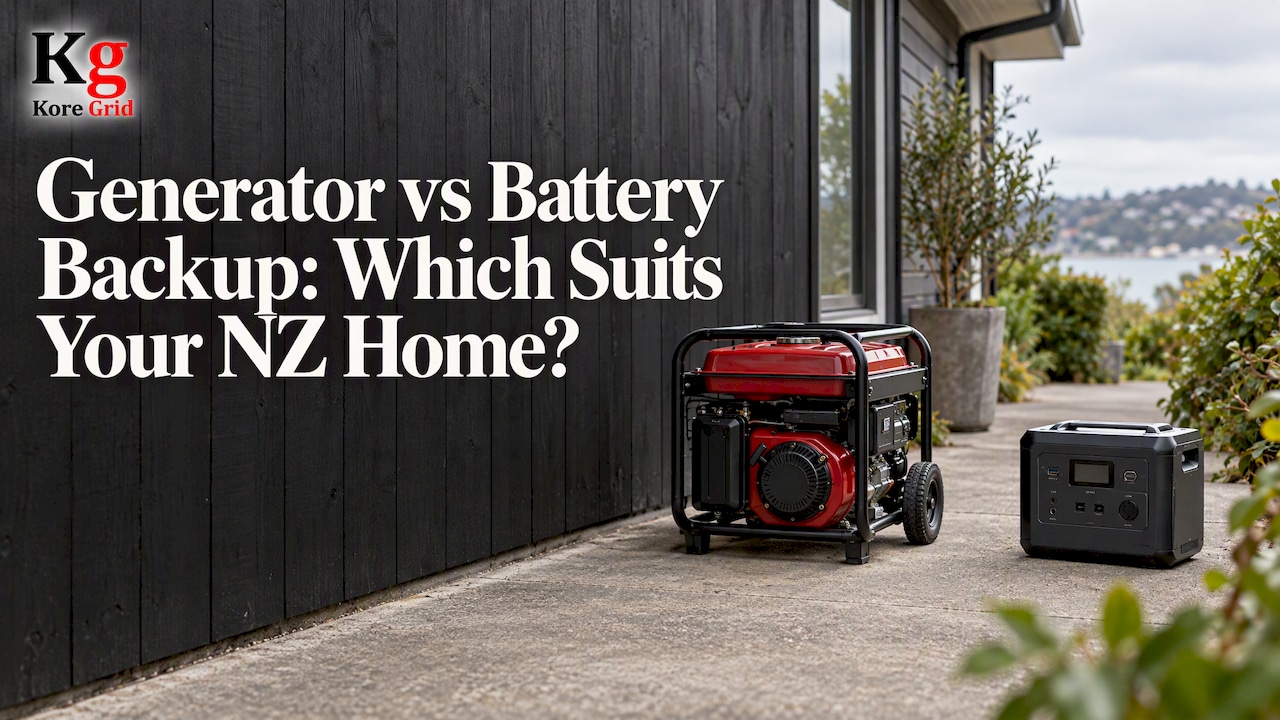
For most New Zealand homes, a battery backup is the better fit for short outages, and a generator is the better fit for outages that run for days. A battery is quiet, starts instantly and can be used indoors. A generator runs for as long as you can keep it fuelled, but it must always stay outdoors. The right choice depends on how long your outages last, what you need to keep running and who lives in the house.
This guide compares the two on the things that matter during a real outage: runtime, safety, cost, noise, upkeep and legal setup in New Zealand.
TL;DR
- Battery backup suits outages of a few hours: lights, phones, internet, a fridge and small essentials. It is silent, needs no fuel and is safe to use inside.
- A generator suits multi-day outages and heavy loads such as a water pump, but it must be used outdoors and needs fuel and regular maintenance.
- Safety is the biggest difference. Generators and other fuel-burning gear can cause lethal carbon monoxide poisoning if used indoors. Batteries do not produce exhaust.
- In New Zealand, connecting a generator to house wiring must be done by a licensed electrical worker. Do not plug one into a power point or switchboard yourself.
- Solar charging closes the gap. A battery that can recharge from solar is not limited to the energy it held when the lights went out.
Table of Contents
- The short version: capacity versus convenience
- How each option works
- Generator vs battery backup at a glance
- Safety: where the two options differ most
- Runtime: the honest limit of batteries
- Cost: purchase price is only part of it
- Who should choose what
- Medical needs and backup power
- Batteries beyond blackouts
- Our perspective
- Looking at battery backup for your home
- Practical tips before the next outage
- FAQ
- Sources
The short version: capacity versus convenience
The trade-off comes down to two words: capacity and convenience. Industry experts quoted by AP News describe a generator’s reliance on fuel as a possible liability in long outages. The same piece says battery systems offer better safety, silence and ease of use for shorter or moderate incidents.
A generator turns liquid fuel into electricity, so its runtime is limited only by how much fuel you have stored safely. A battery stores a fixed amount of energy, so its runtime is limited by its size and by what you plug into it.
Neither is simply better. They solve different problems, and plenty of households are better served by one than the other.
How each option works
Generators
A portable petrol or diesel generator is an engine driving an alternator. You fill it with fuel, start it, and plug appliances in using extension leads. Larger standby generators are wired into the house permanently and start automatically, but they are a bigger and more expensive project.
The engine is the strength and the weakness. It gives you a lot of power for a long time, but it makes noise, produces exhaust and needs maintenance. AP News notes that generators need regular engine upkeep to be reliable after long periods sitting idle. Anyone who has tried to start a mower after winter knows how that goes.
Battery backup
A battery backup stores electricity and releases it when you need it. For households, this comes in a few forms:
- Portable battery units that you plug appliances into, charged from a wall socket or solar panels.
- Trolley-mounted units that are larger and wheel from room to room.
- Modular, stackable units where you add capacity as your needs grow.
- Permanently installed home batteries wired into the switchboard, usually alongside rooftop solar.
The Electricity Authority says around 75,000 New Zealand households now have solar, and over 14,700 of those also have batteries. Permanent systems are a big commitment, though, and are not an option for most renters.
Generator vs battery backup at a glance
| Generator | Battery backup | |
|---|---|---|
| Best for | Multi-day outages, heavy loads, rural properties | Short outages, essentials, urban homes, renters |
| Runtime | As long as you have fuel | Limited to stored energy, unless recharged by solar |
| Use indoors | Never | Yes, no exhaust |
| Noise | Loud | Near silent |
| Start-up | Manual start or fuel check | Instant |
| Ongoing upkeep | Fuel storage, engine servicing, test runs | Keep it charged |
| Connecting to the house | Licensed electrical worker and changeover switch | Plug appliances in directly |
| Everyday use | Backup only | Can also support solar and daily energy use, depending on the system |
The table simplifies things, because products vary. Check the rated output and stored capacity of any unit against what you actually want to run.
Safety: where the two options differ most
Carbon monoxide and generators
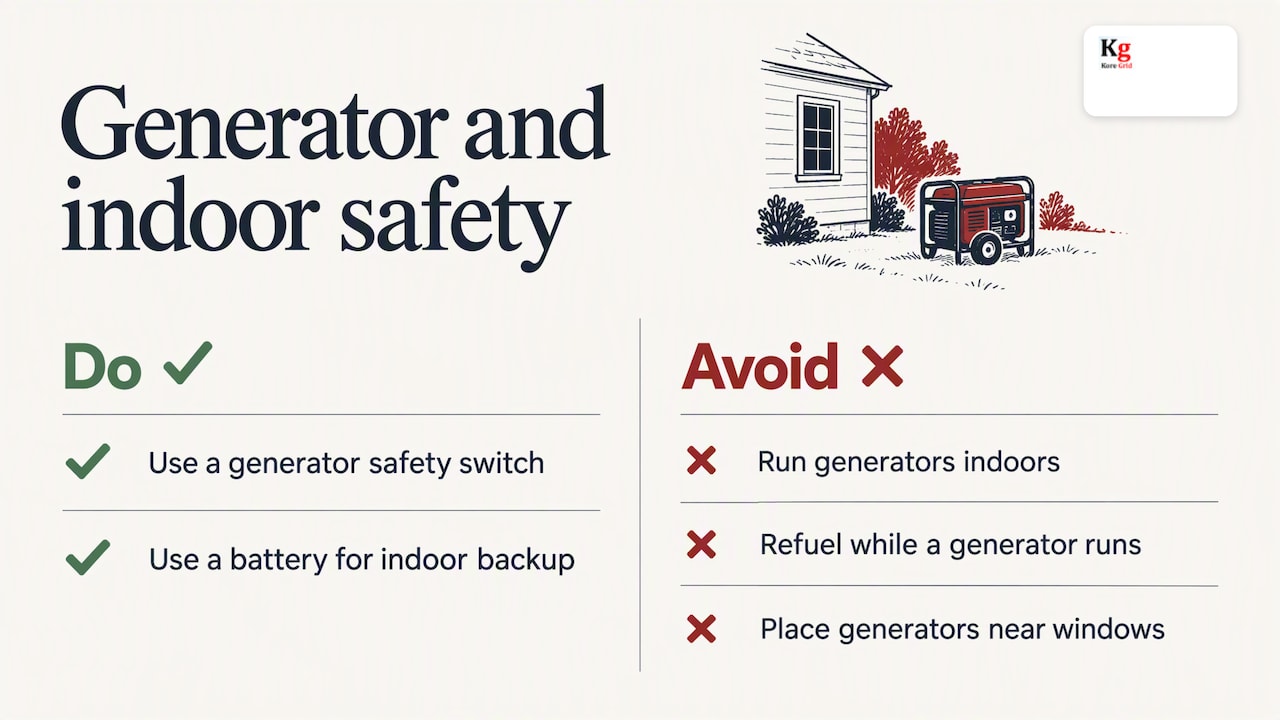
Carbon monoxide (CO) is colourless and odourless, and it kills quietly. A generator must never run in a garage, a shed, a carport attached to the house or near a window. The lines company WEL Networks lists the basics: never use a generator indoors, never refuel it while it runs, and use a safety switch designed for generators.
The same risk applies to other fuel-burning gear. WorkSafe says most deaths linked to camping appliances in New Zealand have come from CO poisoning, and it advises stopping use immediately if an appliance smells, since that can signal incomplete combustion. Many people reach for a camping heater or stove in a blackout. If you cook during outages, our guide to cooking without power in NZ covers safer options.
If you want something you can use inside the home, a battery unit has no exhaust and no flame. That is why it is the natural answer to the question of safe indoor backup power. A battery is not risk-free, since any electrical product needs sensible use, but it removes the CO hazard entirely.
The law on connecting a generator
This is the part many people get wrong. WorkSafe’s guidance is that connecting a generator to house wiring yourself is illegal and dangerous. A small generator with a 10A socket outlet should only supply appliances plugged directly into it. A permanent connection to the main switchboard must be done by a licensed electrical worker with a compliant changeover switch, which stops power feeding back into the network and endangering line crews.
In practice, a generator is either a long extension-lead job for a few appliances or an electrician’s job and a real cost. A plug-in battery unit avoids the question: you plug the appliance into the unit.
Runtime: the honest limit of batteries
Batteries are not infinite. A fixed amount of energy goes in, and what comes out depends on what you connect. A heater or an electric oven can drain a small unit in well under an hour, while LED lights, a phone charger and a router can run for much longer. The draft residential solar and battery guideline from Standards New Zealand makes the same point: if a battery is not linked to solar, once the stored energy is gone it cannot be refilled until the grid returns. A generator can run for days if you have enough safe fuel.
So the question to ask is how long your outages usually last. A few hours is common in a city after a storm. Several days is more realistic for rural areas, or after severe weather or earthquakes.
A simple way to size your need
- List what must stay on. Fridge, lights, phone chargers, router, medical equipment, a heater for a baby’s room.
- Check the wattage. It is on the appliance label or in the manual.
- Estimate the hours. Multiply watts by hours to get watt-hours. Compare that with the unit’s stated capacity.
- Allow for start-up surges. Fridges, freezers and pumps draw several times their running power for a moment when they start.
- Leave a margin. Do not plan to run a battery to zero.
If the total is a few hundred to a couple of thousand watt-hours, a battery handles it comfortably. If you need to run a bore pump, a workshop or electric heating for days, you are in generator territory, or a very large battery and solar setup.
Cost: purchase price is only part of it
We will not quote prices for other makers’ gear, because they change often and vary by brand. What matters is how the costs are structured.
- Generators usually cost less per watt of output upfront. Then you pay for fuel, which has to be stored safely and rotated so it does not go stale, plus servicing. If you need it wired in, add an electrician and a changeover switch.
- Batteries usually cost more per unit of stored energy upfront, but have no fuel bill and little upkeep. If they charge from solar, the sunlight is free.
A generator that sits in the shed for five years and starts first pull is a good deal. One that does not start on the night you need it is not. A battery sitting in a cupboard still needs topping up now and then, but that is a lot simpler than fuel and engine servicing.
Who should choose what
A battery is usually the better fit if you:
- live in an apartment, townhouse or suburban home with short outages;
- rent, and cannot change the wiring;
- want something safe to use inside, with children, pets or older relatives in the house;
- mainly need lights, phones, internet, a laptop and perhaps a fridge;
- want to avoid storing fuel.
Renters in particular face limits on what they can install. Our guide on solar for renters in New Zealand explains what to check, including 230V compatibility, before you buy.
A generator is usually the better fit if you:
- live rurally or on a lifestyle block where outages can run for days;
- depend on a bore or pressure pump, or other heavy loads;
- have a safe outdoor place to run it, and somewhere safe to store fuel;
- are happy to service it and test it regularly.
Consider both if you:
- have a rural property but also want quiet, indoor power for the essentials. A battery covers the first few hours and overnight, and the generator covers the long haul and heavy loads, run safely outdoors.
Medical needs and backup power
If anyone in your home relies on electricity for medical support, such as oxygen equipment or a powered mattress, backup power needs a proper plan, not just a purchase. The Electricity Authority’s emergency response guidance for medically dependent consumers advises you to tell your power company about the dependency. It also advises you to have a tested emergency plan and to identify an alternative location, such as a family member’s home or a hospital, in case your backup runs out or fails.
Talk to your health practitioner or equipment supplier about what backup suits your device and how long it must run. Do not assume a particular battery or generator will keep medical equipment going without checking its output and capacity against the device first.
Batteries beyond blackouts
A generator does one job. A battery can also work when the power is on. Paired with solar, it stores daytime generation for the evening, when most households use the most electricity. The Standards New Zealand draft guideline notes that the evening peak does not line up with solar production, which is exactly the gap a battery fills.
This also affects housing decisions. If you are weighing up a home that already has solar, a US-based checklist on what to check when buying a home with solar is a useful prompt for questions about ownership, age of equipment and paperwork. The rules are American, so apply the ideas to New Zealand conditions and confirm the details with your lines company.
From April 2026, the Electricity Authority has updated its rules so lines companies set a default 10kW export limit for small-scale residential generation, including solar and batteries. That applies to systems connected to the network, and it matters if you are planning a permanent installation.
Our perspective
We talk to New Zealand households about power every day, and the same thing comes up: people buy for the worst outage they can imagine, not the one they actually get. Most blackouts in towns and cities are short. For that case, a generator is often more machine, more noise, more fuel and more risk than the job needs.
We built our energy storage range for the other kind of household: renters, older homeowners and anyone who wants backup they can use without an electrician, without fuel and without running anything outside in the rain. Portable, trolley-mounted and stackable units, each with integrated solar charging, mean you can start small and add capacity later. Solar charging is the key point. A battery that can recharge from the sun is not just a countdown to empty.
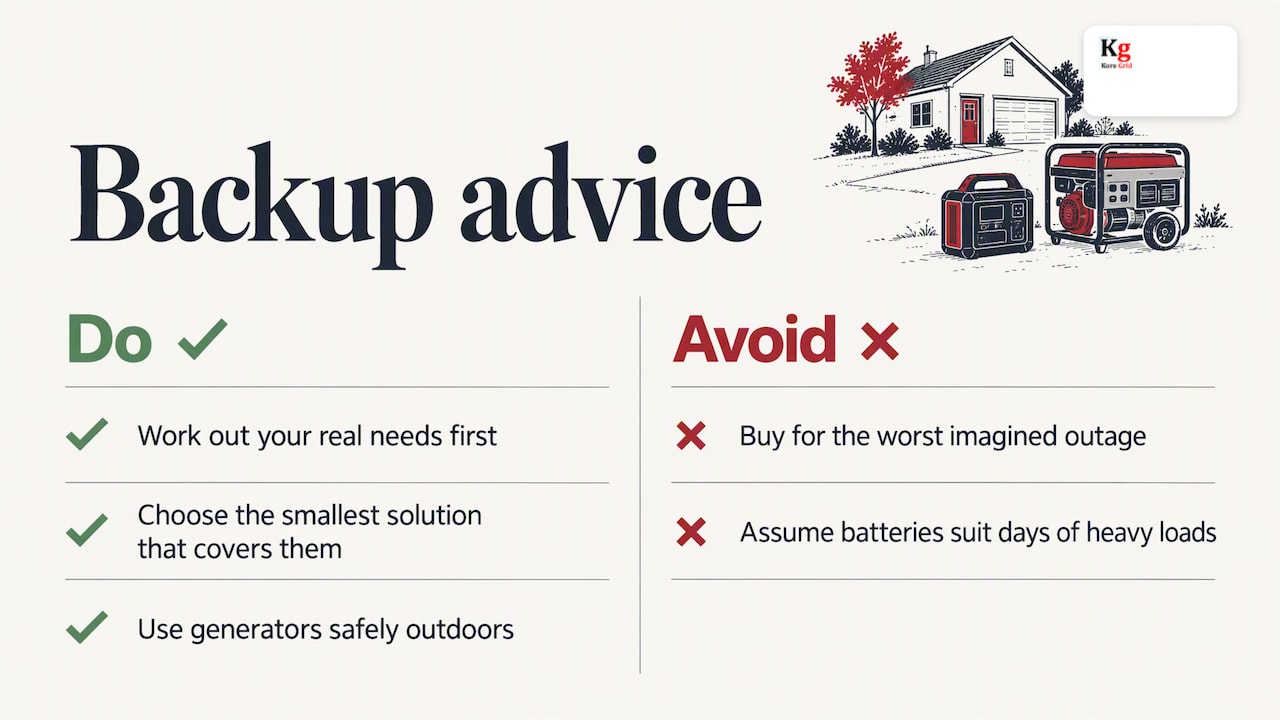
We are also honest about limits. A battery has a fixed amount of energy, and if you need to run heavy loads for days, a unit of any size has to be chosen carefully, and sometimes a generator, used safely outdoors, is the right tool. Our advice is to work out your real needs first, then pick the smallest solution that covers them.
We also think backup is only half of the story. Cutting what your home wastes every day means any backup lasts longer, and our Power-Saving Box guide explains how power factor and electrical losses fit in. It is worth reading alongside our overview of why power saving matters.
— Stan Lieder
Looking at battery backup for your home
If a battery sounds like the right fit, our energy storage range includes the All-in-One Portable ESS, the All-in-One ESS Trolley and the All-in-One Stackable ESS, all with integrated solar charging. Each is designed for flexible backup and storage without permanent installation. You can request a quote through the site, and Afterpay instalments are available as an option. If you want to lower your everyday power bill too, take a look at the Power-Saving Box, a plug-in device that targets electrical losses and improves power factor without installation.
Practical tips before the next outage
- Test it before you need it. Run your battery or generator on a calm day and see what it can actually power.
- Keep batteries charged. Top them up before forecast storms.
- Store fuel safely. If you own a generator, use approved containers and keep them away from the house and heat sources.
- Keep a plan for the fridge. Keep the door closed to hold the cold longer.
- Never improvise a house connection. No cables with two male plugs, no DIY switchboard connections.
- Check CO safety. Keep fuel-burning appliances outside and ventilated, and use CO alarms where fuel-burning appliances are in or near the home.
- Cut your daily load. Appliances such as dehumidifiers add up. See what a dehumidifier costs to run in NZ.
FAQ
Can I use a battery backup instead of a generator?
Yes, for many homes. A battery handles lights, phones, internet and often a fridge through an outage of a few hours, and it is quiet, instant and safe indoors. If you face multi-day outages or need to run heavy equipment such as a water pump, a generator or a much larger battery setup is more realistic.
Is there a safe indoor alternative to a generator?
A battery unit is the usual one. It has no exhaust, so there is no carbon monoxide risk from the unit itself. A generator must never be run indoors, in a garage or close to windows and vents, because the exhaust can be lethal.
Can I plug a generator into my house wiring?
Not yourself. In New Zealand, WorkSafe says DIY connection is illegal and dangerous. A permanent connection needs a licensed electrical worker and a compliant changeover switch. A small generator should only power appliances plugged directly into it.
How long will a battery backup last in a power cut?
It depends on the unit’s capacity and what you connect. Lights, a router and phone chargers use little, while heaters and ovens use a lot. Add up the watts of your essentials and compare the watt-hours with the unit’s rated capacity. Solar charging can extend the time if the sun is out.
Do I need to tell my power company if I rely on medical equipment?
Yes. The Electricity Authority advises telling your power company and keeping a tested emergency plan with an alternative location. Your health practitioner can help you work out what backup your equipment needs.
Sources
- New rules encourage more solar to networks, Electricity Authority
- How to choose the best backup power when the lights go out, AP News
- Using Generators During an Outage, WEL Networks
- Camping appliance safety, WorkSafe
- Connecting a generator to the wiring of a house or building following an emergency, WorkSafe
- Residential solar PV and battery storage systems guideline, Standards New Zealand
- Emergency response plan for medically dependent electricity consumers, Electricity Authority
Leave a Reply