Most home dehumidifiers draw between 300W and 700W while they run. At a typical New Zealand power price, that is roughly $1 to $1.50 for a full day of running. Used sensibly, a compressor unit costs about $80 to $180 over a winter. Left on continuous mode, the same unit can cost much more. This guide shows you how to work out your own number and where the extra dollars usually come from.
TL;DR
- Most NZ household dehumidifiers draw 300W to 700W when running. A 400W unit running 8 hours a day uses about 3.2 kWh, or roughly $1.12 at 35c/kWh.
- Sensible winter use of a compressor unit costs about $80 to $180 a season. Desiccant models run continuously can reach $250 to $500 or more.
- Humidistat setting matters most. Aim for 55 to 60% humidity rather than 45%, and avoid continuous mode and forgotten laundry mode.
- A drier home is also easier and cheaper to heat, so the unit often pays part of its way back.
- Your power price and run-time decide the real cost. The formula below takes two minutes.
Table of Contents
- How to work out what your dehumidifier costs to run
- Why the numbers vary so much
- The settings that quietly raise your bill
- What humidity level should you aim for?
- Ten ways to cut dehumidifier running costs
- Does a dehumidifier pay for itself?
- Our perspective: look at the whole power bill
- If you want to look at the wider bill
- FAQ
- Sources
How to work out what your dehumidifier costs to run
Every appliance bill comes from the same sum:
- Take the watts printed on the unit’s label and divide by 1,000 to get kilowatts.
- Multiply by the hours it actually runs. That gives kilowatt hours (kWh).
- Multiply by your power price per kWh. You will find it on your latest bill.
The same simple formula is used by price comparison guides for any appliance. The important phrase is “actually runs”. A dehumidifier with a humidistat does not draw full power all day. The compressor switches off once the room reaches your target humidity. The fan may keep going, but it uses far less.
Worked examples at 35c per kWh
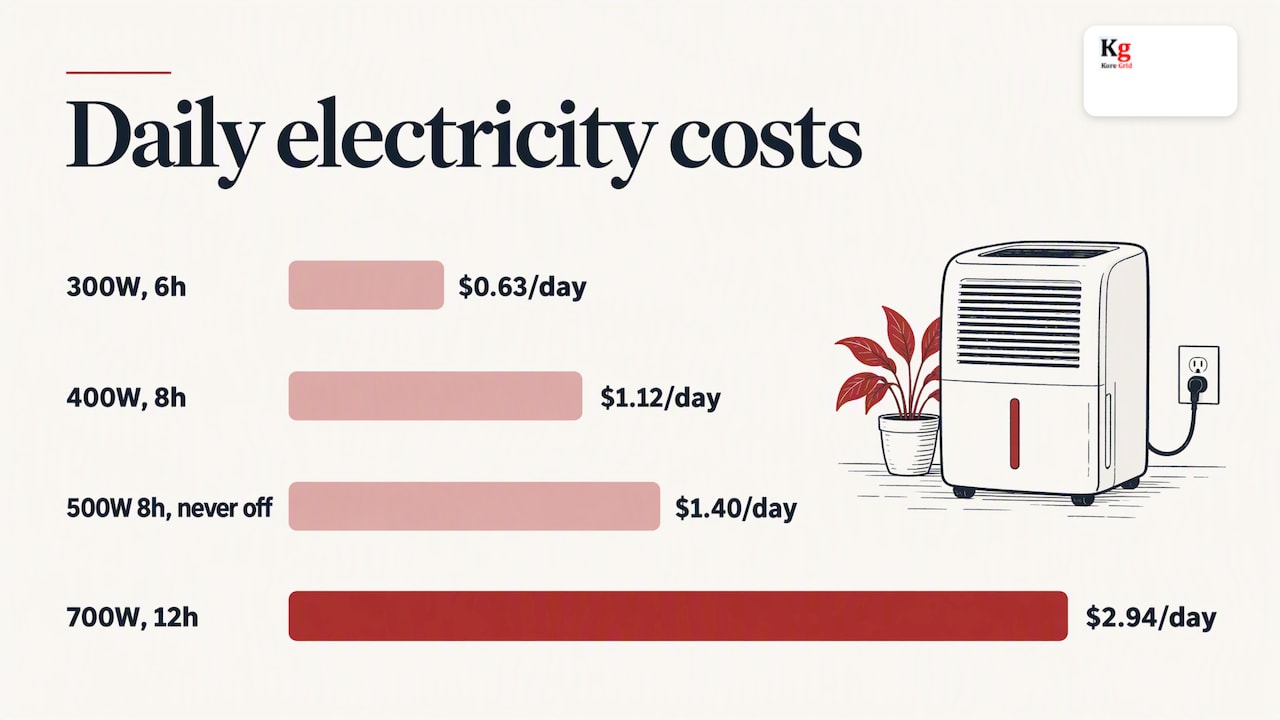
The table uses 35c/kWh, the rate in the PoweredNZ example. Your rate will differ by retailer and region, and PoweredNZ notes that national averages have been sitting higher than that in some areas. Swap in your own price.
| Scenario | Daily use | Cost per day | Cost over 30 days |
|---|---|---|---|
| 300W, 6 hours | 1.8 kWh | $0.63 | $18.90 |
| 400W, 8 hours | 3.2 kWh | $1.12 | $33.60 |
| 500W, 8 hours, never cycling off | 4.0 kWh | $1.40 | $42.00 |
| 700W, 12 hours | 8.4 kWh | $2.94 | $88.20 |
The 400W line matches the research figure of about 3.2 kWh a day in humidistat mode. The other lines are our own arithmetic from the same formula, so treat them as illustrations, not measurements.
One local calculator shows the effect of cycling. It estimates that a 350W unit run 6 hours a day at 28c uses about 2.1 kWh, around $0.59 a day, and roughly $89 across a five-month damp season. Cycling on a humidistat can make that lower still.
Why the numbers vary so much
Compressor or desiccant
There are two main technologies, and they behave differently in the cold.
- Compressor units cool a coil so moisture condenses on it. They are cheaper to run, but lose significant efficiency below about 15°C because the coil cannot pull as much water from cold air.
- Desiccant units use a heated wheel to regenerate the drying material. They keep working in cold rooms such as a garage or unheated hallway, but they draw a lot more power to do it.
That is why PoweredNZ puts sensible compressor use at $80 to $180 a season and continuous desiccant use at $250 to $500 or more. Pick the technology to suit the room’s usual temperature. A desiccant unit in a cold garage may be the right tool, but it is a poor choice for a warm living room.
Size and settings
Retail guides give slightly different ranges. Mitre 10’s guide says most units use 200W to 500W depending on size and settings, while PoweredNZ puts the typical household range at 300W to 700W. Read the label on your own unit rather than relying on an average. Newer models are generally more efficient to run than old ones, though that source does not give a figure.
Run-time
PoweredNZ suggests a realistic winter run-time of 6 to 12 hours a day if the unit is used sensibly. A damp rental with no extractor fan and a wet bathroom will sit at the top of that range. A well-ventilated home will sit at the bottom.
The settings that quietly raise your bill
Continuous mode
Many units come set to continuous running or an aggressive humidity target. Mitre 10 describes leaving a unit on continuous as a common mistake. The machine keeps working after the room is already at a healthy level.
Too low a target
PoweredNZ says a setting of 55 to 60% is generally enough for comfort and mould prevention in NZ homes. Setting it to 45% can push consumption up by 30 to 50% with no extra benefit. There is also a comfort reason to stop there. MBIE’s technical methodology notes that humidity below 45% can worsen dry skin or eczema.
Laundry mode
Laundry modes often override the humidistat, so the unit runs flat out whether or not the air is dry. PoweredNZ warns that forgetting it on after the clothes are dry is an easy way to spike a monthly bill.
As for the cost of drying washing this way, Consumer NZ’s reporting is useful. A five-hour laundry-mode run to dry one load used 1.9 kWh, about 50c, comparable to a full cycle in a modern vented dryer, with the added drawback of noise. Their winter laundry article also points out the health cost of all that moisture staying in the house. If you can dry clothes outside on a fine day, do that.
What humidity level should you aim for?
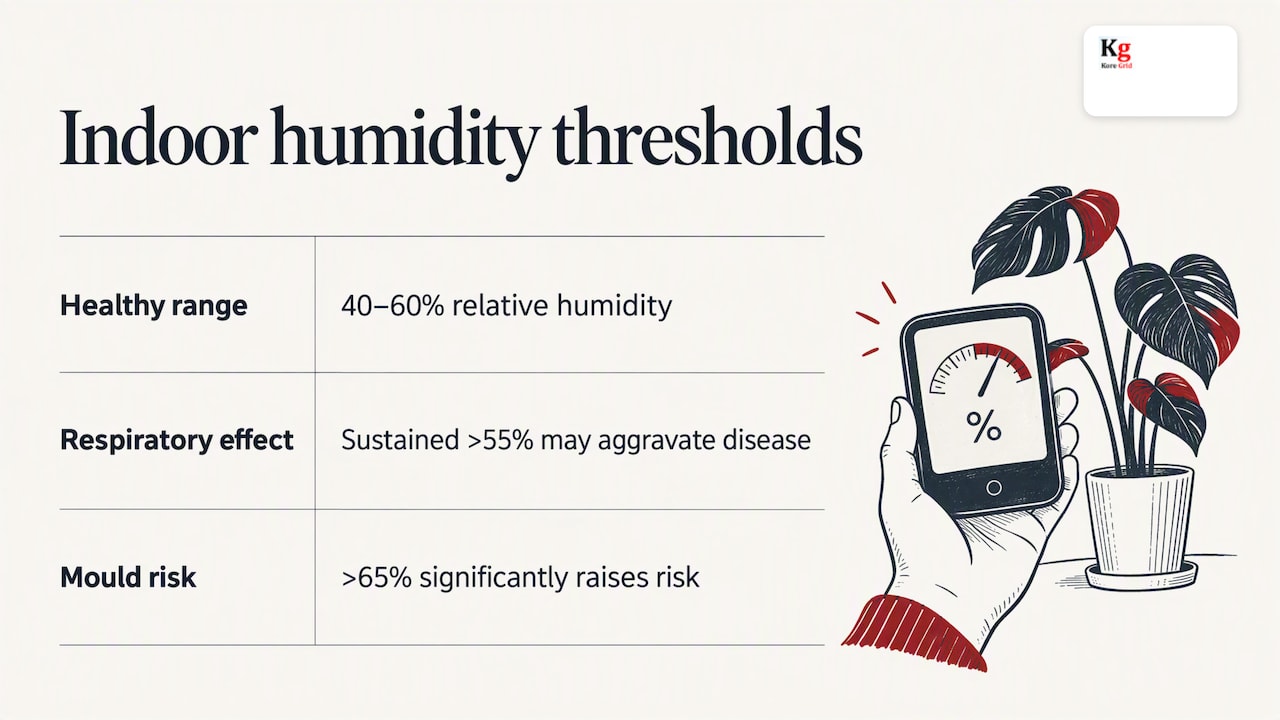
A drier house is not the goal. A healthy one is. The MBIE methodology document points to a healthy range of roughly 40 to 60% relative humidity. It says sustained humidity above 55% can aggravate respiratory disease, and going past 65% significantly raises the risk of mould.
A cheap hygrometer (a humidity gauge) takes the guesswork out. If you live with COPD or another breathing condition, WebMD’s COPD guidance recommends measuring indoor humidity so you do not overuse a dehumidifier, because air that is too dry can cause problems as well. Ask your GP or practice nurse what range suits your condition.
Ten ways to cut dehumidifier running costs
- Use the humidistat. Set it to 55 to 60% and let the unit cycle off.
- Close doors and windows in the room while it runs, so it is not drying the whole street.
- Cut the moisture at the source. Health NZ suggests opening windows, using extractor fans, putting lids on pots and wiping condensation off windows.
- Dry washing outside when the weather allows.
- Run it in the warmest part of the day if you have a compressor unit, since it works better above 15°C.
- Match the unit to the room. An oversized unit in a small bedroom wastes power. An undersized one runs all day.
- Keep the filter clean and the water tank emptied so it can run properly. If it has a drain hose, use it.
- Switch laundry mode off when the clothes are dry.
- Check your power plan. If your retailer offers cheaper off-peak rates, a timer lets the unit run then.
- Look at the whole house. Draughts, unvented dryers and cold surfaces all add to the load.
Does a dehumidifier pay for itself?
Partly. Health NZ says dehumidifiers can be a useful tool for managing dampness as part of a broader strategy. They are often more energy-efficient than a heat pump for dehumidifying alone, and a drier home is easier and cheaper to heat. So the $1 or so a day is not all extra cost. Some of it comes back as lower heating use, though the amount depends on your house.
Condensation on windows and cold surfaces is also a dew point question: moisture appears where a surface is colder than the dew point of the air. This dew point checklist for metal buildings explains the principle clearly, even though it is written for sheds and garages rather than homes. The same logic applies to a cold exterior wall in a bedroom.
Our perspective: look at the whole power bill
We make plug-in power-saving boxes for New Zealand homes, so we spend a lot of time looking at where household electricity goes. Here is what we see in plain language.
A dehumidifier is one of those appliances that is easy to forget. It runs in the background, often in a rental, and nobody notices the extra kWh until the bill lands. The first step is always the free one: check the settings, set a sensible target and stop it running when no one needs it.
The second step is to look at the rest of the house. Fridges, heaters, heat pumps and motors all lose some electricity as waste, and some of that waste relates to power factor. Our Power-Saving Box is built to target those electrical losses. It plugs in, needs no installation and can go with you when you move, which suits renters and older homeowners who do not want major upgrades or an electrician on site.
We will be straight about the limits. A power-saving box will not dry your house and does not replace a dehumidifier. It is one possible helper for the electricity side of the bill, and results depend on your home and the appliances in it. Fix the damp first, then look at efficiency.
— Stan Lieder
If you want to look at the wider bill
Once your dehumidifier settings are sorted, the Koregrid Power-Saving Box is worth a look. It plugs in, needs no installation, and is designed to reduce electrical losses and improve power factor in your home. Prices are not published on the site, so you can request a quote for your situation. If you also want backup power or storage with solar charging, we offer portable, trolley and stackable energy storage units.
FAQ
How many watts does a dehumidifier use?
Most household units use between 300W and 700W while running, according to PoweredNZ. Smaller units can be lower. The wattage is on the label near the power cord.
Does a dehumidifier use a lot of electricity?
Not if you use it properly. A 400W compressor unit in humidistat mode uses about 3.2 kWh a day, or roughly $1.12 at 35c/kWh. It becomes expensive when it runs continuously, is set to a very low humidity target, or is a desiccant model running in a mild room where it does not need to be.
Is it cheaper to run a dehumidifier or a clothes dryer?
They can be similar. Consumer NZ found a laundry-mode load used 1.9 kWh, about the same as a modern vented dryer cycle, though noisier. Line-drying outside costs nothing in electricity.
What humidity should I set my dehumidifier to?
A setting of 55 to 60% is generally enough for comfort and mould control in NZ homes. Going down to 45% can lift consumption by 30 to 50% without extra benefit. A hygrometer will tell you what your rooms are really doing.
Should I leave a dehumidifier on all day?
Only in humidistat mode, so it cycles off by itself. Continuous mode keeps running after the room is dry. Check the room’s humidity and the unit’s settings before leaving it for long periods.
Sources
- Dehumidifier Running Costs in NZ Winter 2026, PoweredNZ
- Operational Efficiency Assessment: Technical Methodology, MBIE
- Keeping your home healthy, Health NZ
- Remove damp and control mould with a dehumidifier, Mitre 10
- Dehumidifier Running Cost Calculator NZ
- COPD and Humidity: Tips to Help you Prepare, WebMD
- Dehumidifier Running Cost per Hour, Free Price Compare
Leave a Reply