kWh and kVA measure two different things, so you can’t swap one for the other. A kilowatt-hour (kWh) is an amount of energy used over time. A kilovolt-ampere (kVA) is a rating of the total electrical load a system has to carry at a given moment. One is a quantity, like litres of water used. The other is a capacity, like the width of the pipe.
The confusion usually comes from a third unit sitting between them: the kilowatt (kW). Once you see how kW, kWh and kVA connect, generator labels, solar quotes and power bills start to make sense. This guide explains each unit, shows the sums with real numbers, and covers the DC versus AC question that often comes up alongside it.
TL;DR
- kWh is energy: how much electricity you use over time. It is the unit on your power bill.
- kW is real power: the rate at which a device does useful work right now.
- kVA is apparent power: the total load a generator, transformer or inverter must handle, including power that does no useful work.
- kW and kVA are linked by power factor (kW = kVA × power factor). kWh and kVA can’t be converted directly, because one involves time and the other doesn’t.
Table of Contents
- The three units side by side
- kW: how hard the device is working
- kWh: how much energy you actually used
- kVA: the total load, not just the useful part
- Power factor: the link between kW and kVA
- Why you can’t convert kWh to kVA
- DC vs AC: the other half of the confusion
- Will a 25 kVA generator run a house?
- What this means for your power bill
- Our perspective
- FAQ
- Sources
The three units side by side
| Unit | What it measures | Everyday comparison | Where you see it |
|---|---|---|---|
| kWh (kilowatt-hour) | Energy used or stored over time | Litres of water used | Power bills, battery capacity |
| kW (kilowatt) | Real power at one moment | How fast water is flowing | Appliance ratings, solar panel output |
| kVA (kilovolt-ampere) | Apparent power, the total load | The full width of the pipe | Generator and transformer ratings, inverter sizing |
The rest of this article unpacks each row, starting with the one most people already half-know.
kW: how hard the device is working
Power is measured in watts, and a kilowatt is 1,000 watts, as Transpower explains in its guide to the grid. A kettle rated at 2,000 W is a 2 kW device. A heat pump might be 1 to 3 kW depending on the size and how hard it is running.
kW measures real or active power, the part that performs useful work: heating the water, spinning the compressor, lighting the room. It is a snapshot. It tells you nothing about how long the device has been running.
kWh: how much energy you actually used
A kilowatt-hour is power multiplied by time. Unison defines it as the amount of electrical energy consumed over a period, for example a 1,000-watt device running for one hour. Transpower gives the same example.
Some quick worked examples:
- A 2 kW kettle running for 3 minutes (0.05 of an hour) uses 0.1 kWh.
- A 1.5 kW heat pump running for 4 hours uses 6 kWh.
- A 100 W lamp left on for 10 hours uses 1 kWh.
The same unit describes batteries. A battery sold as 5 kWh can, in simple terms, supply 1 kW for five hours or 5 kW for one hour. That is why the question “kW vs kWh” matters when you shop for storage: kWh tells you how long it lasts, and kW tells you how much it can run at once.
If you want to see where your own kWh go, our guide on what a dehumidifier costs to run in NZ is a good example of turning a watt rating and run time into a real number.
kVA: the total load, not just the useful part
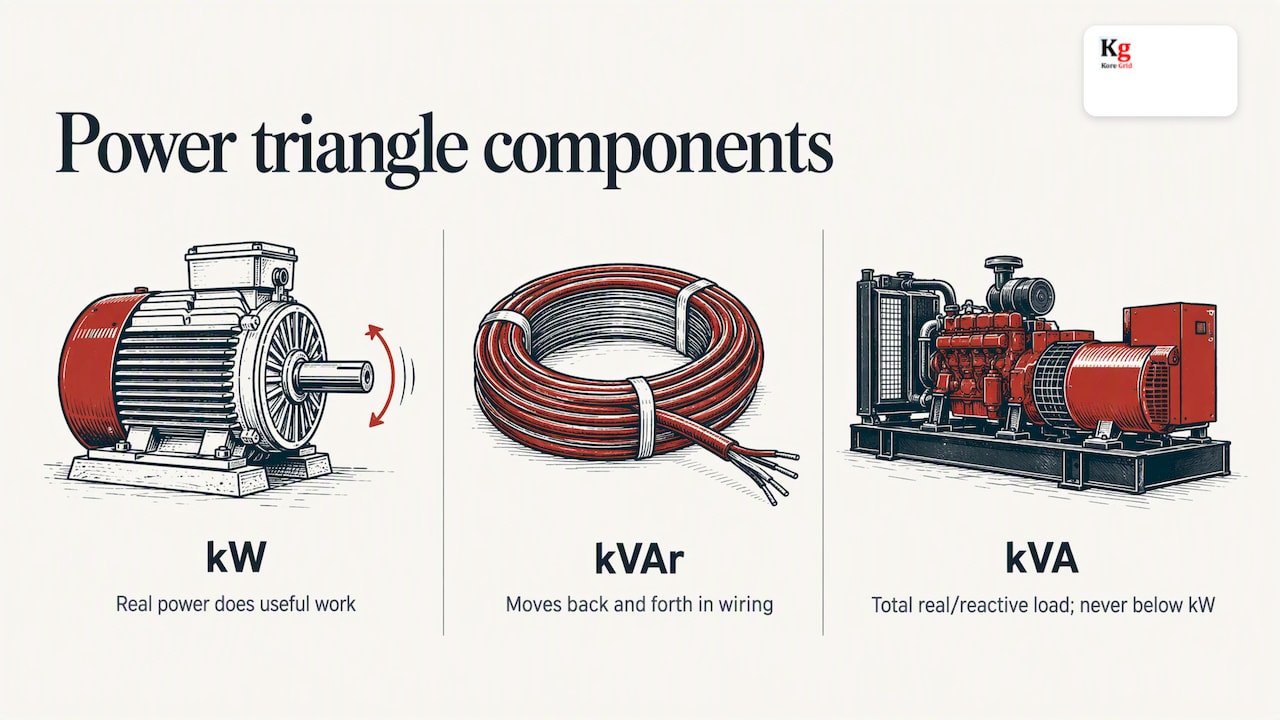
In New Zealand, kVA stands for Kilo Volt Amperes. It measures apparent power, which is the total load in the system. That total includes the real power doing the work and a reactive component that moves back and forth in the wiring without doing any work. One calculator aimed at NZ three-phase users describes kVA as covering both the real and reactive parts.
Engineers often draw this as a triangle. Real power (kW) is one side, reactive power (kVAr) is another, and apparent power (kVA) is the long side. This is the power triangle commonly used to explain why kVA is never smaller than kW.
Why does this matter? Because wires, generators and transformers have to carry the full current, not only the useful part. Genpower notes that kW is mainly used to rate equipment that does work, while kVA is used to size infrastructure like generators and transformers that must handle the whole load. That is why generator labels say kVA.
Power factor: the link between kW and kVA
Power factor (PF) is the ratio of useful power to total power. Genpower gives the formula as PF = kW ÷ kVA. Rearranged, it gives you the two sums you actually need:
- kW = kVA × PF
- kVA = kW ÷ PF
Schneider Electric says the same thing for sizing equipment: to find kVA, divide the load in kW by its power factor. You need only two numbers: the load in kW and the power factor.
A power factor of 1 (unity) means every bit of current does useful work. Motors, compressors and some older transformers or fluorescent lighting gear tend to pull a lower power factor. Lagging power factors, which come from inductive loads, can be corrected with capacitive components, according to the NZQA unit standard for electrical trades.
A worked example
Say a workshop motor draws 4 kW of real power at a power factor of 0.8.
- kVA = 4 ÷ 0.8 = 5 kVA
The motor does 4 kW of work, but the supply has to carry 5 kVA. Now improve the power factor to 0.95:
- kVA = 4 ÷ 0.95 = about 4.2 kVA
Same work, less total load. A lower power factor means a higher kVA demand for the same real power, which is the whole reason power factor gets attention. If you want the household version of this idea, our explainer on power factor and what it means for your home goes through it step by step.
Going the other way
A generator labelled 10 kVA with a power factor of 0.8 can deliver about 8 kW of real power (10 × 0.8). People who read “10 kVA” as “10 kW” overestimate what it can run by a fifth. The error is bigger with a lower power factor.
Why you can’t convert kWh to kVA
Several top-ranking pages offer a “kWh to kVA calculator”. It helps to understand what such a tool is really doing, because the conversion is not a straight swap.
kWh is energy, which is power × time. kVA is a rating at one moment, with no time in it. To go from one to the other you need two extra inputs:
- A time period. Dividing kWh by hours gives you average kW. For example, 30 kWh used over 24 hours is an average of 1.25 kW.
- A power factor. Dividing that kW by the power factor gives you kVA. At 0.9, 1.25 kW is about 1.39 kVA.
So the chain is: kWh ÷ hours = kW, then kW ÷ PF = kVA. Be careful with the result, though. An average hides peaks. If your home averages 1.25 kW across a day but briefly hits 7 kW when the oven, kettle and heat pump are all on, the 7 kW peak is what a generator or inverter has to cope with.
In short:
- Use kWh to understand how much you use, how long a battery lasts and what you are paying for.
- Use kW and kVA to size equipment that has to carry the load at a given moment.
DC vs AC: the other half of the confusion
Many readers land on kVA pages while really trying to work out what DC and AC mean for a battery, solar panel or inverter. The plain version:
- AC (alternating current) reverses direction constantly. In New Zealand it does so at 50 Hz, and it is easier to step up or down in voltage using transformers. That is why the grid and your wall sockets use it.
- DC (direct current) flows one way only. Batteries and solar panels produce and store DC.
So when a solar-plus-battery product lists a DC input and an AC output, it means the panels feed DC in, and an inverter turns it into AC so your appliances can use it. AC output is the figure that matters for running household appliances, and it is usually rated in watts or kW. The inverter’s own limit may also be rated in VA.
The same Transpower guide uses a hose analogy that helps here: current (amps) is the flow, and voltage (volts) is the pressure. Multiply them and you get VA, the apparent power. If you are weighing up solar in a rental, our piece on checking 230V before you buy solar covers the practical side. For storage that charges from panels, see how a solar charging battery works.
Will a 25 kVA generator run a house?
This is one of the most common questions beside the kVA search. The honest answer is that a 25 kVA generator is large for most homes, but the label alone doesn’t settle it.
Step one is converting to kW. At a power factor of 0.8, 25 kVA is about 20 kW of real power (25 × 0.8). Plenty of New Zealand homes would struggle to use that much at once.
Step two is the load. Sizing a generator depends on the total continuous running load plus the largest single starting (surge) load. Motors, compressors and pumps draw a burst when they start. For anything beyond basic appliances, the same source suggests a professional load assessment to avoid undersizing or oversizing.
A practical way to check it yourself:
- List what you want to run during an outage, with each device’s watt rating.
- Add them up for the running total in kW.
- Note the biggest motor-driven item and allow extra for its start-up surge.
- Divide the total kW by the generator’s power factor to find the kVA you need.
If you are choosing between a generator and a battery for outages, we compare them in generator vs battery backup for NZ homes.
What this means for your power bill
Your household is charged for energy, so kWh is the figure to watch. kVA matters mainly for the equipment around you: the supply capacity, the generator, the inverter or the transformer in the street.
That said, power factor still touches your home. A device with a poor power factor draws more current than its real power needs. On the network side, the Electricity Authority is working on reactive power management with technical advisers and the System Operator, which shows the topic is being taken seriously across the grid.
At home, the simplest wins come first: efficient appliances, sensible heat pump use and drying clothes smartly. Our heat pump efficiency tips are a good place to start, and if lights dim or flicker when big appliances start, this checklist on flickering lights explains when to call an electrician.
Where a power-saving box fits
If you want a plug-in way to work on losses and power factor without rewiring, that is what the Power-Saving Box is for. It plugs in at a power point, needs no installation, and suits renters and older homeowners who can’t or don’t want to alter the house. You can read the details in the Power-Saving Box guide or see the Power-Saving Box itself. If you also want backup or solar-charged storage, the portable, trolley and stackable units are on our energy storage products page. Savings depend on your household, so we suggest looking at the potential energy savings page before you decide.
Our perspective
Most of the confusion we hear about comes from one habit: treating every electrical number as “how much power”. In practice each unit answers a different question. kWh answers “what did I use or store?”. kW answers “how hard is it working right now?”. kVA answers “how much can the supply carry?”.
We build for New Zealand households, many of them renting, so we pay attention to what a person can change without an electrician or a landlord’s sign-off. That is why our products are plug-in and portable. When you read a spec sheet, check three things: the kWh for how long it runs, the kW for what it can run at once, and the power factor if the rating is in kVA. If a number doesn’t come with a unit or a power factor, ask before you buy.
We would also rather you understand the numbers than trust a headline figure. Savings vary from home to home, and a clear explanation of how your household uses power will serve you better than a promise.
— Stan Lieder
FAQ
Are kVA and kW the same thing?
No. kW is real power doing useful work, and kVA is apparent power, the total load including the reactive part. They are equal only when the power factor is 1. Otherwise kW = kVA × power factor, so kVA is always the larger or equal number.
What is the difference between kW and kWh?
kW measures power at a moment, and kWh measures energy over time. A 1,000-watt device running for one hour uses one kWh. Think of kW as the speed and kWh as the distance travelled.
How do you calculate kVA?
Divide the load in kW by the power factor. For example, 6 kW at a power factor of 0.9 is about 6.7 kVA. If you only have kWh, first divide by the hours to get average kW.
What does kVA stand for?
It stands for kilo volt amperes, meaning 1,000 volt-amperes. It is the product of voltage and current, so it describes the total electrical load without reference to how much of it does useful work.
Is DC or AC the output I should look at on a battery?
Look at the AC output if you want to run normal household appliances, because they use AC. DC figures describe the panels and battery side. The inverter between them converts one to the other, and its rating limits what you can run at once.
Sources
- Electricity glossary, Electricity Networks Association NZ
- What is the difference between kW and kVA? (Genpower)
- kVA to kW Calculator, NZ three-phase
- Why is kVA not the same as kW? (Engineering StackExchange)
- Formula to determine kVA on a transformer (Schneider Electric)
- Outcomes and performance criteria (NZQA)
- kW to kVA formula (CalcPanel)
- A Guide to Transpower
- Electricity words we use (Unison)
- Generator size calculator (Power Projects)
- Reactive power flows and voltage coordination workshop (Electricity Authority)
Leave a Reply