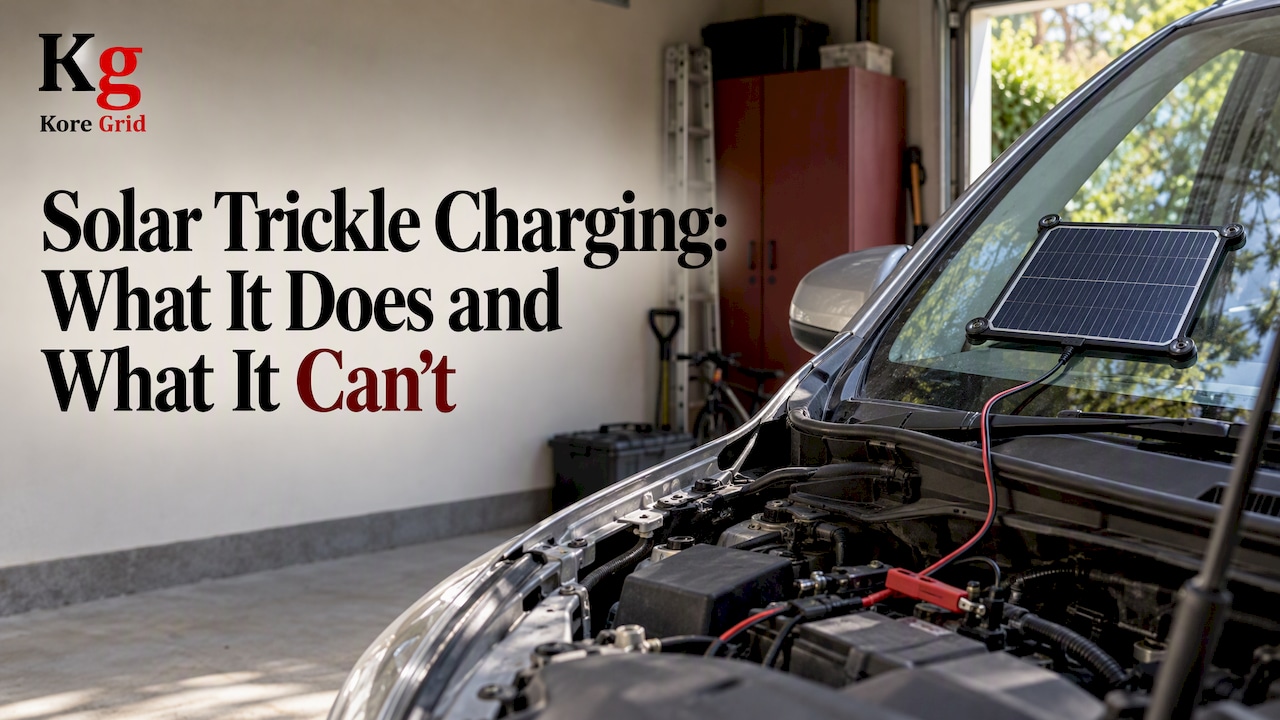
Solar trickle charging uses a small solar panel to feed a battery a tiny, steady current. It offsets the battery’s natural self-discharge, so a car, boat, tractor or standby battery stays full while it sits unused. It does not power your home, and it will not bring a flat battery back to life. If you want to cut your power bill or keep the lights on in an outage, you need something different, and we explain what below.
TL;DR
- A solar trickle charger is a maintenance tool. Typical panels run from 1.5W to 10W, enough to match self-discharge and nothing more.
- It suits batteries that sit idle: vehicles, boats, caravans and standby units. It is not suitable for running household appliances or recovering a dead battery.
- Small maintenance-only chargers generally sit outside the grid-export rules. Anything with real output or grid export must meet Part 6 of the Electricity Industry Participation Code.
- To lower household electricity costs, a trickle charger is the wrong tool. Plug-in efficiency and proper storage are closer to the job.
Table of Contents
- How solar trickle charging works
- Where a solar trickle charger earns its place
- What a trickle charger can’t do
- Choosing a solar trickle charger
- Is it legal to connect solar gear at home in New Zealand?
- When a trickle charger isn’t enough
- Our perspective: a trickle charger and a home energy product solve different problems
- If you want more than a trickle
- A note on green claims and timing
- FAQ
- Sources
How solar trickle charging works
A solar trickle charger is a small panel, a cable and a pair of clips or a plug. Sunlight turns into a small direct current, which flows one way into the battery. A blocking diode stops the current flowing back out at night.
The current is deliberately tiny. According to Renewable Energy Advisors, a 1.5W panel produces roughly 0.08 to 0.125 amps. That matches the rate a healthy battery loses charge just by sitting there. Because the flow is so small, the battery can’t be overcharged even if you leave the charger connected for months.
That is the whole idea. The charger does not add charge in any useful quantity. It simply stops the slow slide to flat.
Trickle charging versus a normal charger
A mains battery charger pushes a much higher current and is meant to refill a battery that has been used. A trickle charger only maintains one that is already full. Mixing up the two is the most common reason people are disappointed with a cheap solar unit.
| Solar trickle charger | Mains battery charger | Larger solar and storage system | |
|---|---|---|---|
| Typical output | 1.5W to 10W | Much higher, from a wall socket | Hundreds of watts and up |
| Main job | Hold a full battery full | Recharge a used battery | Store power and supply a home or circuit |
| Recovers a dead battery | No | Often, depending on battery type and condition | Not its purpose |
| Runs household appliances | No | No | Yes, within its rating |
| Needs sun | Yes, even a little | No | Yes, if solar charging is the source |
Where a solar trickle charger earns its place
The best uses share one trait: a battery that is used rarely but needs to start when called on.
- Cars and motorcycles stored over winter. A small panel on the dashboard, plugged into the accessory socket, can keep the starter battery from drifting down. Note that some vehicles cut power to the socket when switched off, so check yours.
- Boats on a mooring or trailer. Bilge pumps and electronics draw a little, and boat batteries sit for weeks.
- Tractors, farm bikes and ride-on mowers. These are used seasonally and stored in sheds with no power.
- Caravans and campervans. A standby house battery benefits when the rig sits in the driveway.
- Gates, fences and small standby systems. Low-draw loads away from the house can benefit from a panel that tops up a small battery.
If you have an outage-prone spot and want practical ideas for the bedroom side of things, see bedside pedestals for load-shedding homes.
What a trickle charger can’t do
This is where expectations need resetting, because a lot of search results blur it.
It won’t recharge a flat battery. As Renewable Energy Advisors explains, a battery that has lost significant capacity needs a jump-start or a mains charge first. A 1.5W panel simply doesn’t have the output to recover it.
It won’t run your fridge, heat pump or lights. The output is a fraction of what a household appliance draws. Using the word “solar” next to “charger” can make it sound like a mini power station. It isn’t.
It won’t lower your power bill in any measurable way. A trickle charger maintains a battery, usually one that isn’t connected to your house at all. Your bill depends on what you draw from the grid and when.
It isn’t a fix for a battery that is failing. If a battery goes flat quickly even with a charger attached, the battery is probably worn out. Have it tested by an auto electrician or a battery specialist.
Choosing a solar trickle charger
You don’t need to spend much, but a few checks save frustration.
- Match the voltage. Most car, boat and motorcycle batteries are 12V. Check the battery label and the charger rating.
- Pick a sensible wattage. For a stored car or motorcycle, a panel in the 1.5W to 10W range is typical. Larger batteries or cold, cloudy conditions point towards the upper end.
- Look for a blocking diode or controller. It prevents the battery draining through the panel overnight.
- Choose the connection that suits your setup. Alligator clips go straight to the terminals. A cigarette lighter plug is simpler, but only works if the socket stays live.
- Think about placement. A panel behind a windscreen loses some output to the glass and tint. Garaged vehicles get little or no sun, so a panel on the windscreen may do nothing at all.
- Check the battery chemistry. Lead-acid and lithium batteries have different charging needs. Confirm the charger is compatible before connecting it.
Once it is connected, glance at the battery every few weeks. If it won’t hold charge, replace the battery rather than expecting the panel to do more.
Is it legal to connect solar gear at home in New Zealand?
For a small maintenance charger on a car battery, there is no practical issue. The Electricity Authority explains that small, maintenance-only devices generally don’t fall under the grid-export rules that apply to household solar systems.
The picture changes when a system can produce meaningful power or send electricity back to the grid. Those systems are approved by the local lines company to protect grid frequency, voltage and stability, and they must comply with Part 6 of the Electricity Industry Participation Code 2010. If your device has any export capability, talk to your installer or your local lines company first.
When a trickle charger isn’t enough
People searching this topic often have a bigger goal than keeping a battery alive. They want lower power costs, or some independence from the grid. That is a reasonable thing to want in New Zealand right now.
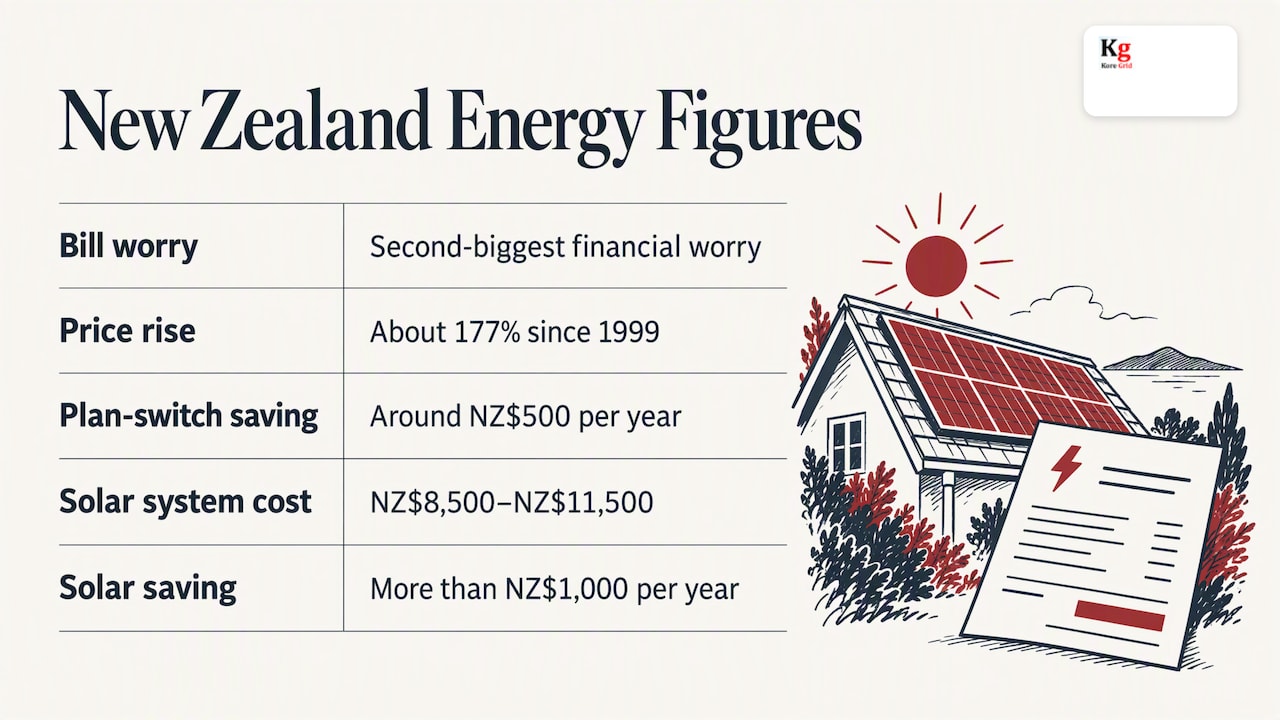
Consumer NZ reported in August 2026 that power bills are the second-biggest financial worry for New Zealanders. Electricity prices have risen about 177% since 1999, nearly double the rate of inflation. The same release says the average household saving from switching to a more competitive plan is around NZ$500 a year.
Full rooftop solar is one route. The Ministry for Regulation says a typical small to medium system costs between NZ$8,500 and NZ$11,500 and can save households more than NZ$1,000 a year. Only about 3 to 4% of New Zealand households have solar. The same page notes the process can drag on for months, with multiple site visits and approvals, and the government has launched a review to cut that cost and complexity.
That works well if you own your home and can wait. It doesn’t work for many renters, or for older homeowners who don’t want a major project. For those readers, the question becomes what you can do without building work.
Three options, by type
- Shift your usage. The Electricity Authority points to load shifting, which means moving high-energy tasks to off-peak times, as the fastest way to get value from your energy spending. Consumer NZ suggests running the washing machine and dishwasher after 9pm and charging an EV overnight.
- Reduce electrical losses at home. A plug-in device that improves power factor needs no installation and moves with you. See our Why Power Saving? page for the thinking behind it.
- Add portable storage with solar charging. This is the realistic step up from a trickle charger: a battery system you can use for backup and for running real loads.
Lines charges also matter. The Electricity Authority notes they make up about 40% of a typical bill, which is a reminder that no single gadget will remove your power costs. Each step trims a part of the bill.
Our perspective: a trickle charger and a home energy product solve different problems
We talk to people every week who start with “solar trickle charging” and end up asking a different question. They don’t actually want to maintain a boat battery. They want to stop overpaying for electricity, or they want to keep a few essentials running when the power goes out.
So we draw a clear line. A trickle charger is a good, cheap tool for a stored battery, and we’d happily point you to one for that job. It is not a household energy product, and calling it one does readers a disservice.
For homes, we focus on two things. The first is the Power-Saving Box, a plug-in unit designed to reduce electrical losses and improve power factor without installation. That matters for renters and for elderly homeowners on tight budgets, who can’t or don’t want to rewire or mount anything. We don’t promise a fixed saving, because it depends on your household, and we suggest you look at the examples on our potential savings page and read our Power-Saving Box guide for realistic expectations.
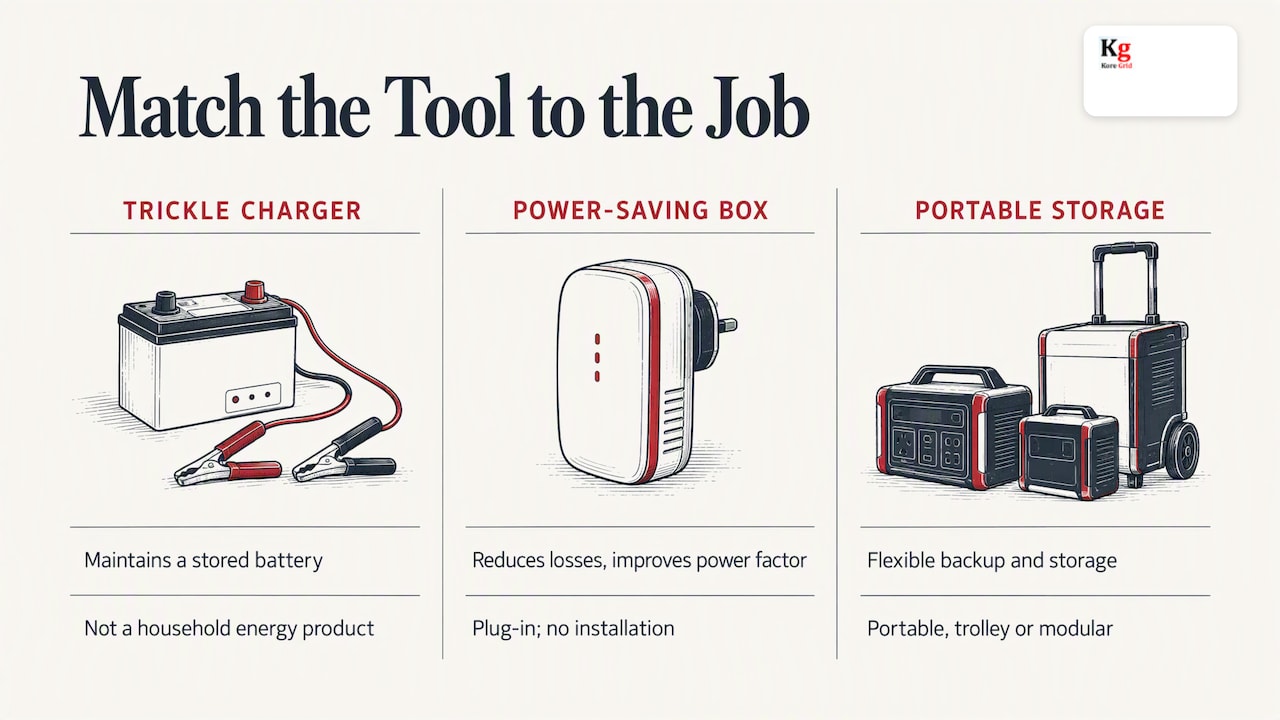
The second is portable energy storage with integrated solar charging, in portable, trolley-mounted and modular stackable versions. These are for flexible backup and storage, not permanent installations. If you rent, our post on solar for renters explains why checking 230V compatibility before you buy anything is worth the few minutes.
Our view is simple: match the tool to the job, and be honest about what each tool can’t do.
— Stan Lieder
If you want more than a trickle
If your real aim is lower power costs or backup power without a building project, take a look at our range. The Power-Saving Box plugs in and needs no installation. The All-in-One Portable, Trolley and Stackable ESS units combine storage with solar charging. We don’t publish prices on the site, so request a quote and we’ll point you to the right fit for your home.
If you are weighing storage against a petrol generator for outages, our comparison of generator versus battery backup covers the trade-offs for NZ homes. If you’re thinking about the kitchen during a blackout, we’ve also covered how to cook without power safely.
A note on green claims and timing
Whichever route you take, remember that grid power is one shared pool. Consumer NZ points out that a retailer’s “100% renewable” claim doesn’t mean the electricity at your socket came only from renewable sources. At peak times, typically breakfast and early evening, the pool includes coal and gas generation.
That’s why storage and timing matter together. Stored solar energy is most valuable when it is used at the times the grid is under the most strain, not just when the sun is out.
FAQ
Will a trickle charger recharge my battery?
Not a flat one. A trickle charger delivers only enough current to offset natural self-discharge on a battery that is already healthy. If a battery has lost significant charge, it needs a jump-start or a mains charge first, then the trickle charger can maintain it.
Can I leave a solar trickle charger connected all the time?
Yes, that is what it is designed for. The current is small enough that it can’t overcharge the battery, and a blocking diode stops it draining overnight. Still, check the battery now and then, and confirm the charger suits your battery chemistry.
Can a solar trickle charger run anything in my house?
No. At 1.5W to 10W it produces far too little power for household appliances. For running real loads during an outage or reducing grid use, you need a portable energy storage system with solar charging, sized for what you want to power.
Is a trickle charger worth it for a car that is rarely driven?
Usually, yes, provided the panel gets light. A small unit on the dashboard can hold a starter battery steady through weeks of idle time. If the car lives in a dark garage, a panel won’t help, and a mains maintainer is a better choice.
Sources
- How Does a Solar Trickle Charger Work? (Renewable Energy Advisors)
- Solar power (Electricity Authority)
- Solar review launched to cut cost and complexity (Ministry for Regulation)
- Power bills overtake housing as New Zealanders’ second-biggest financial concern (Consumer NZ)
- How green is your power company? (Consumer NZ)
Leave a Reply