You can cook without power in New Zealand by using no-cook food, or by using an outdoor LPG or butane cooker or a barbecue. Both fit official NZ guidance, which also lists a camp stove or an open fire (where fire rules allow). The one firm rule is that fuel-burning cookers stay outside. The rest of this guide covers what to do in the first hour, what to eat, how to heat food and water, and how to plan so you are not hunting for gear in the dark.
TL;DR
- The safest first meal needs no cooking: canned food, crackers, nuts, spreads, cereal and long-life milk.
- Portable gas cookers, barbecues and camping appliances belong outdoors. Never use them in a kitchen, garage, tent or caravan.
- Open fires depend on current fire-season rules, so check Fire and Emergency New Zealand before lighting one.
- Plan for three days or more, with at least 9 litres of drinking water per person and extra for cooking and cleaning.
- A battery system can run some low-power appliances, but it is not a replacement for a safe outdoor cooker. Check its output rating first.
Table of Contents
- What to do when the power goes out while you are cooking
- Eat in the right order
- Meals that need no cooking at all
- Safe ways to heat food and boil water
- Water: the part people forget
- What about battery backup?
- Our view: simple beats clever
- Build a no-power kitchen kit before you need it
- If you rent or have limited space
- How we can help
- FAQ
- Sources
What to do when the power goes out while you are cooking
If the power fails mid-meal, work through this short list:
- Turn off the appliance if it is safe to do so, and move away from flames or hot cookware. Health New Zealand gives this as the first step.
- Leave pots where they are until you can handle them safely. Hot oil and a dark kitchen are a poor mix.
- Find a torch before you do anything else. A phone torch is fine for a few minutes, but save the battery.
- Decide whether to finish the meal outside or switch to no-cook food.
- Keep the fridge and freezer doors shut.
That last point matters more than most people expect. Power failure affects fridges and freezers, and HealthEd notes that food in them will go bad over time. Every time you open a door, you let the cold out.
Eat in the right order
Food planning in an outage is a sequence, not just a recipe problem. Civil Defence guidance on being stuck at home points to using fridge food first, then freezer food, then cupboard and emergency-kit food.
In practice:
- Fridge first. Eat milk, cooked leftovers, deli meat and anything perishable before it turns.
- Freezer second. Keep the door closed and take out only what you will eat soon.
- Pantry last. Canned and dried food will keep, so it is your reserve.
Health New Zealand also advises checking for rotting or spoiled food. Throw out anything that smells bad or looks spoiled. Avoid cooking more than you can eat in one sitting, because leftovers are risky when you cannot rely on refrigeration.
Meals that need no cooking at all
The lowest-risk plan is food you never have to heat. Get Ready lists long-lasting food that does not need cooking as a core supply, unless you already own a camping stove or gas barbecue. The first-meal foods it points to include canned fish or meat, beans, soup, fruit, crackers, cereal, nuts, spreads, dried fruit, long-life milk and bread.
Some easy combinations:
- Tinned tuna or chicken on crackers or bread, with a piece of fruit.
- Baked beans or canned spaghetti, eaten cold or warmed gently on an outdoor cooker.
- Muesli or cereal with long-life milk.
- Peanut butter or other spreads on bread, with dried fruit and nuts.
- Tinned soup. It is perfectly edible cold, and better warm if you have a safe outdoor heat source.
Pack a manual can opener with the food. An electric one is no use, and a lot of people only discover that when the lights are already out. If anyone in your home needs special foods for medical reasons, store those with the rest so the plan does not rely on finding them in the dark.
Safe ways to heat food and boil water
There is no single best option. The right one depends on your home, the weather and where you live. Here are the common choices and how they compare.
| Option | Works outdoors | Indoor use | Main thing to check |
|---|---|---|---|
| Portable LPG or butane cooker | Yes | No | Appliance condition, a stable non-combustible surface, spare gas |
| Gas barbecue | Yes | No | Gas bottle level, safe distance from buildings |
| Camp stove | Yes | No | Manufacturer instructions, fuel type |
| Open fire or wood fire | Depends on fire season | No | Local fire-season rules, extinguishing gear |
| Charcoal barbecue | Yes | Never | Outdoor use only; produces carbon monoxide |
| Battery system | Not applicable | Yes, for suitable loads | Usable capacity, output rating, appliance wattage |
Portable gas cookers and barbecues
A portable LPG or butane cooker is the most practical option for most households. WorkSafe New Zealand says to use one on a stable, non-combustible surface, to maintain it and operate it exactly as its instructions specify, and to use camping appliances outside whenever possible.
A few habits that follow from that guidance:
- Inspect the cooker before you need it. Do not wait for the outage to find a perished seal or an empty canister.
- Keep it away from anything that can burn, including fences, curtains, dry grass and decks with loose items.
- Let it cool fully before you change a gas canister or refuel.
- Test it once a year, in daylight, with a real pot of water.
Why “just open a window” is not enough
It is tempting to run a camp cooker in the kitchen with a window open. Do not. WorkSafe explains that carbon monoxide is highly toxic and that a faulty appliance can give it off even in well-ventilated areas. You cannot see or smell it. The simple, safe decision is to take fuel-burning cooking outside, and that includes garages, tents and caravans, which count as confined spaces.
If you or anyone at home feels dizzy, gets a headache or becomes nauseous while a fuel appliance is running, switch it off, get into fresh air and call 111.
Open fires and wood-fired cooking
Cooking over a fire is possible in some places, but it is not automatic. Fire and Emergency New Zealand sets out rules for open-air fires that change with the fire season, and if you cannot meet the safety requirements you cannot light a fire. Never leave a fire unsupervised, and call 111 immediately if it gets out of control.
That makes a fire a back-up of a back-up. In a restricted fire season, in a suburban section with close neighbours or in high wind, it may simply not be an option. Check your local conditions first.
Household gas appliances
Some household gas appliances may keep working in an outage, depending on their design. Many gas hobs have electric ignition, so you may be able to light them with a long match or lighter, but that varies by model. Check your appliance manual before assuming it works, and do not assume any gas burner, fire pit or barbecue is safe to use where you plan to use it.
Boiling water without power
Boiling water is the single most useful thing a cooker does in an outage. It makes tea, coffee, instant soup, porridge and rehydrated food, and it gives you hot water for washing up. Put a lidded pot on your outdoor LPG cooker or barbecue side burner and bring it indoors once it is off and safe to carry.
A few practical tips:
- Use a small, lidded pot. It heats faster and uses less gas.
- Fill a thermos flask while the water is hot, so you have hot drinks later without lighting anything again.
- If your tap water is affected, treat water for drinking as your local council or Health New Zealand advises. Storing water ahead of time is easier.
Water: the part people forget
Cooking uses water, and so does cleaning up. Get Ready says to store at least nine litres per person for three days, which covers drinking and basic hygiene only. That works out at 3 litres per person per day. You need extra for cooking and cleaning.
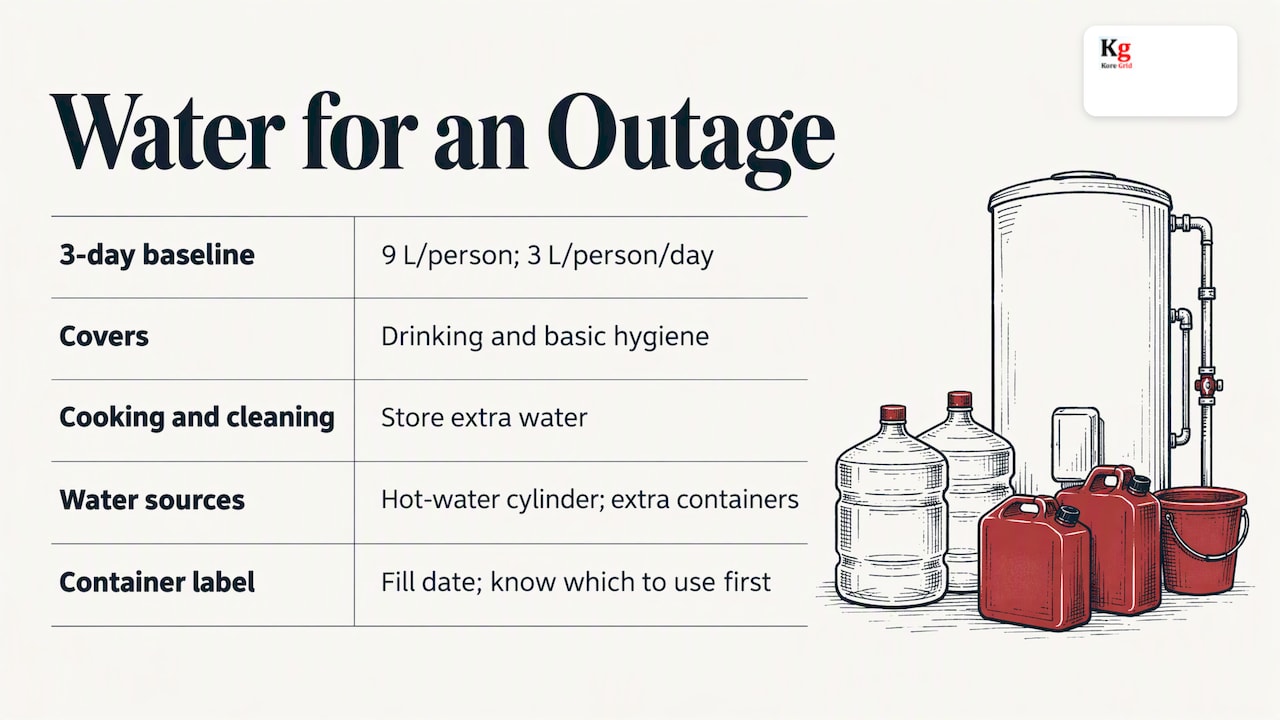
Civil Defence also notes you can use the water in your hot water cylinder, but suggests storing some extra in containers as well. Label the containers with the fill date so you know which to use first.
What about battery backup?
A battery system can change an outage a lot, but it helps to be realistic about what it does.
EECA’s community resilience material shows that solar and batteries, designed and installed for the site, can support cooking, refrigeration, lighting and communications during grid outages. For a typical home, the sensible reading is that storage works for chosen loads, not for everything at once.
Before you rely on one for cooking, check four things:
- Usable capacity. How many watt-hours can you really draw?
- Output rating. Can it supply the watts the appliance needs, continuously?
- Charging method. Mains only, or solar too? Solar charging matters if the outage lasts days.
- The appliance. Check the wattage on its label. A small appliance such as a kettle, rice cooker or slow cooker draws very different power from a full oven or hob.
A battery is also not an unvented fuel cooker, so it does not replace the outdoor rule above. It does, however, keep a fridge, lights, a phone charger and a small appliance going without any flame or fumes, which is a real safety advantage for people who would struggle to manage gas outside.
Our view: simple beats clever
We build products for New Zealand households that want to use electricity more efficiently, so we spend a lot of time thinking about how people actually use power at home, and what happens when it stops.
Here is where we land. First, no single gadget makes you prepared. Official guidance makes the same point: a household is better placed when it has no-cook food and water even if it owns a cooker, because fire restrictions, damaged equipment, bad weather or poor ventilation can take fuel cooking off the table.
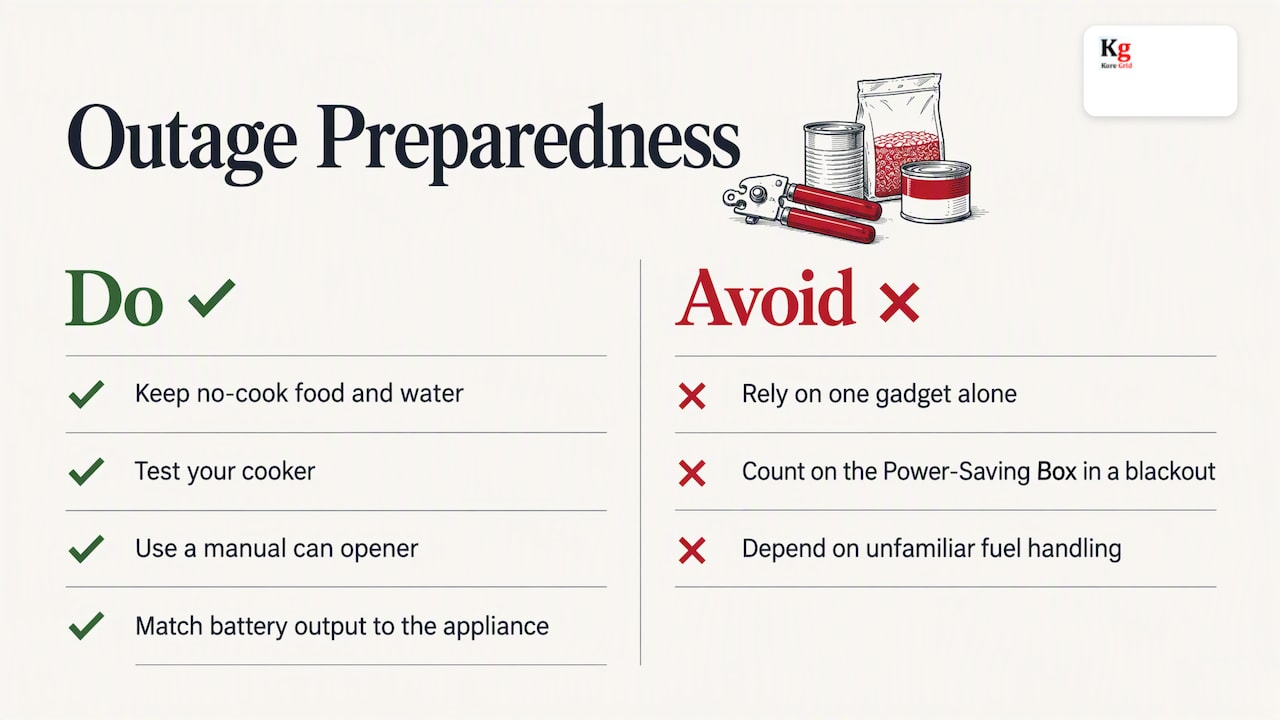
Second, simplicity is a safety feature. For renters and older homeowners in particular, a cooker you have tested, a manual can opener, labelled water containers and easy-open food are worth more than a clever system that needs installing, heavy lifting or unfamiliar fuel handling. Many renters cannot install anything permanent anyway, and many older people do not want to wrestle a gas bottle in the dark.
Third, be honest about what each product does. Our Power-Saving Box is a plug-in device designed to reduce electrical losses and improve power factor in your home, with no installation. It works on your everyday bills, not during a blackout, because it needs mains power to do its job. Our portable energy storage units are the part of our range relevant to outages, and even there, you should always match the unit’s output to the appliance you want to run.
— stan
Build a no-power kitchen kit before you need it
Putting this together takes an afternoon and a modest budget. Keep everything in one tub or box, ideally near the door you would use to go outside.
Food and water
- At least three days of tinned, dried and no-cook food, as HealthEd recommends
- Long-life milk, crackers, nuts, spreads, dried fruit and muesli bars
- Food for babies, pets and anyone with medical needs
- Stored water, labelled with the date
Cooking and eating
- Outdoor LPG or butane cooker, tested, with spare gas
- Lidded pot, thermos flask, long match or lighter
- Manual can opener, plates, cutlery, a pot scrubber and washing-up liquid
Light and power
- Torches and spare batteries, stored with the kit
- A portable phone charger. Get Ready lists a torch and a portable phone charger in its household supplies
- Some cash, since Civil Defence warns that power cuts can affect EFTPOS and ATMs
Check the kit each time the clocks change, and swap out food nearing its date.
If you rent or have limited space
Renters often cannot add a gas bottle, a fireplace or a solar panel to a rental, and a small flat may have no safe outdoor spot. Older homeowners may find gas bottles heavy and fiddly. If that is you:
- Rely first on no-cook food and a stocked cupboard. It needs no fuel and no skill.
- Choose a small, light cooker if you want one, and check you can lift and set it up easily before buying.
- Ask a neighbour, friend or family member whether you could cook together outside in an emergency.
- Think about a portable battery unit for selected loads such as lights, a phone and a small appliance. It plugs in and moves with you when you leave.
How we can help
If you want a flexible way to keep selected appliances running without any permanent install, our range of portable, trolley-mounted and stackable energy storage systems all include integrated solar charging. They suit renters and homeowners who want backup and storage they can move. Pricing is by quote request or checkout, with the option to pay in instalments through Afterpay.
If your main goal is lower power bills day to day, the Power-Saving Box is a plug-in option that needs no installation.
Whichever you consider, tell us what you want to run and for how long. That decides the right size far better than any generic recommendation.
FAQ
Is there a way to cook without electricity?
Yes. You can eat no-cook food, or heat food on an outdoor LPG or butane cooker or a barbecue. WorkSafe says these appliances should be used outside whenever possible. Open fires are an option only if current fire-season rules allow them.
Is there a type of stove that does not need electricity?
A portable LPG or butane cooker runs without mains power, and some household gas appliances may also work in an outage depending on their design. Portable units are not automatically safe indoors. Check the manual and your local Fire and Emergency New Zealand rules rather than assuming any burner or barbecue is fine.
Can I use a camp stove or barbecue inside if I open a window?
No. Carbon monoxide can build up in small spaces, and a faulty appliance can give it off even where ventilation looks adequate. Use the cooker outside, on a stable, non-combustible surface, and never in a garage, tent or caravan.
What should I eat if the power goes out?
Start with fridge food, then freezer food, then your pantry. For meals that need no heat, choose canned fish or meat, beans, soup, fruit, crackers, cereal, nuts, spreads and long-life milk. Throw out anything that smells bad or looks spoiled, and keep the fridge and freezer closed as much as you can.
How much water should I store?
Civil Defence says at least 9 litres per person for three days, which covers drinking and basic hygiene only. Get Ready says you need more for cooking and cleaning. Plan extra, and store it in labelled containers.
Sources
- Protecting Your Health in an Emergency, HealthEd
- During an emergency, Health New Zealand
- Camping appliance safety, WorkSafe
- Work out what supplies you need, Get Ready
- Stuck at home, Get Ready
- No water, Get Ready
- No power, Get Ready
- Open air fire rules, Fire and Emergency New Zealand
- Community resilience site information, EECA
Leave a Reply