Power factor is a number between 0 and 1 that shows how much of the electricity flowing into your home is doing useful work. A power factor of 1.0 means all of it is. A power factor of 0.8 means 80% is doing useful work and 20% is non-working reactive power. Businesses with big motors worry about it because their utility can charge for it. In a New Zealand home the picture is more modest, and we will be straight with you about that below.
TL;DR
- Power factor is the ratio of real power (kW, the part that works) to apparent power (kVA, the total supplied). Closer to 1.0 is better.
- Modern homes full of LED lights, chargers and TVs have a different kind of power factor problem (harmonic distortion) from older motor-heavy buildings (phase shift).
- Household bills in New Zealand are based on kWh used plus fixed daily charges, so a better power factor mainly reduces internal losses and equipment stress. It is not a guaranteed cut to your bill.
- Any plug-in device that claims to improve power factor should be matched to the loads in your home. Ask what it is designed for before you buy.
Table of Contents
- What power factor means in plain language
- How to read the number
- Why low power factor matters
- Does power factor affect a New Zealand power bill?
- Two kinds of power factor: phase shift and distortion
- What is happening on the New Zealand network
- Lagging, leading and the 0.8 you keep seeing
- How power factor gets corrected
- Our view: where a plug-in box fits
- A simple way to see your own power factor
- Practical ways to use less power at home
- Where our products fit
- FAQ
- Sources
What power factor means in plain language
Electricity from the wall carries two kinds of power at once.
- Real power (kW) runs your kettle, heats your room and spins your washing machine drum.
- Reactive power (kVAR) does no work. It sloshes back and forth between your appliance and the grid because some equipment needs a magnetic field to operate.
- Apparent power (kVA) is the total of the two, and it is what your wiring and the network have to carry.
Power factor is real power divided by apparent power. The US Department of Energy gives a worked example: 100 kW of real power with 142 kVA of apparent power gives a power factor of 0.70. The system had to carry 42% more than the work actually needed.
The coffee mug picture
The IEA 4E guide to power factor basics uses a coffee mug. The mug is the total power you pay the network to deliver (kVA). The coffee is the useful energy (kW). The foam is the reactive part (kVAR). A power factor of 1.0 is a mug of coffee with no foam. The more foam, the less coffee you get for the same size mug.
It is a simple picture, and it holds up well. Foam takes up room in the mug but you can’t drink it.
How to read the number
Power factor is written as a decimal (0.85) or a percentage (85%). Here is how to read common values.
| Power factor | What it means | Typical situation |
|---|---|---|
| 1.0 (100%) | All supplied power does useful work | Resistive loads such as a basic heater element or an old-style incandescent bulb |
| 0.95 | 5% of the supplied power is non-working | A common target for commercial sites. The US Department of Energy notes many utilities charge extra below 0.95 |
| 0.8 (80%) | 20% is non-working reactive power | Lightly loaded motors, older fluorescent fittings with magnetic ballasts |
| 0.7 (70%) | 30% is non-working | Heavily inductive loads with no correction |
If you have wondered what 0.8 means: the system carries 1.25 kVA for every 1 kW of real work. The wires, switchgear and transformers have to be sized for the larger figure.
Why low power factor matters
A low power factor means more current flows for the same useful work. More current brings three consequences:
- More heat in the wiring. Losses in a cable rise with the square of the current, so a small increase in current is a larger increase in wasted heat.
- Less spare capacity. The same circuit can carry less useful load. The US Department of Energy notes that low power factor reduces a system’s distribution capacity by increasing current flow.
- Possible penalties. Large commercial and industrial customers can be billed for it. That is where most online articles on power factor are aimed.
For homes, the first two matter more than the third. We cover that next.
Does power factor affect a New Zealand power bill?
For most households, not directly. The Electricity Authority explains that domestic electricity bills are based on the real power you use in kWh, not on apparent power in kVA. Your bill is the energy used plus fixed charges. The government’s consumer site Billy describes a bill as two key parts: the power you have used and the prices and charges that apply.
So if someone tells you that raising your power factor will cut your bill by a set percentage, treat that with care. Utility penalties for poor power factor are generally for large industrial users, not households.
What a better power factor can do at home:
- Reduce the current drawn from your circuits for the same useful work, which trims heat losses in your own wiring.
- Reduce stress on some equipment.
- Free up a little capacity on a circuit that is near its limit.
How much this is worth in dollars depends on your home, your appliances and your wiring. It is not something a general article can promise, and we would rather you hear that from us than discover it later.
The fixed-charge part of your bill
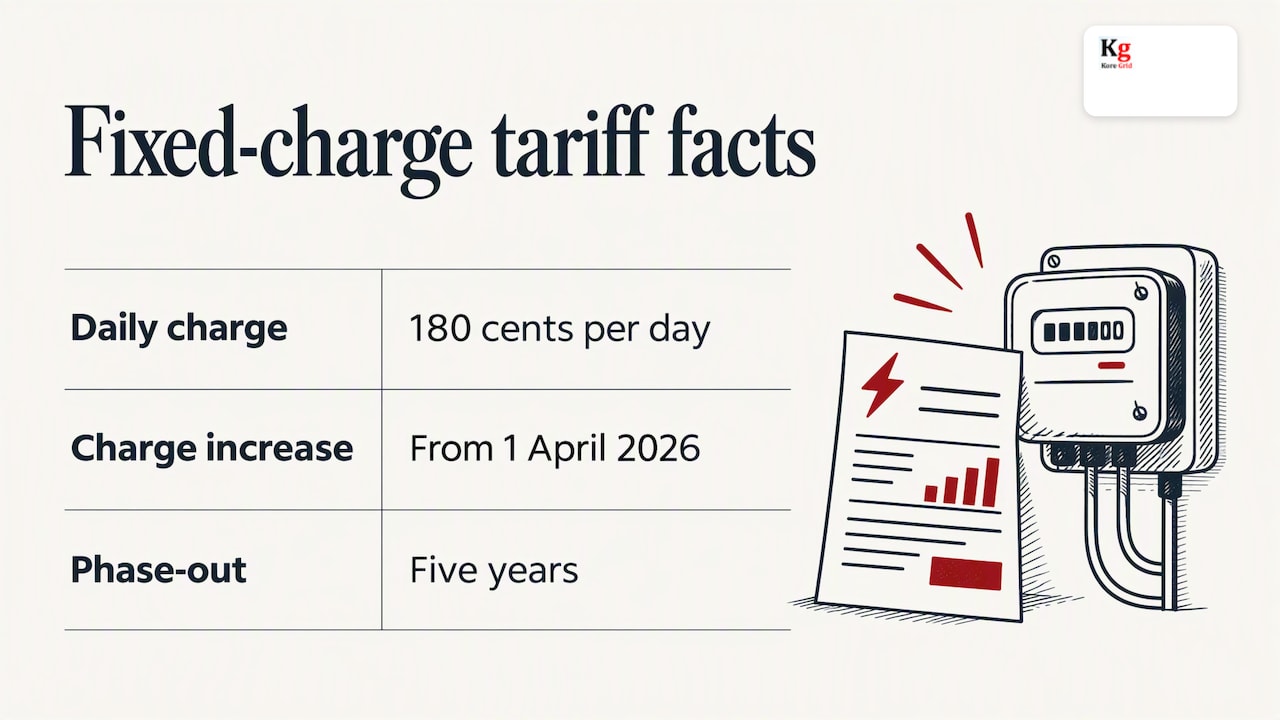
A lot of the bill has nothing to do with how efficiently you use power. The low fixed charge tariff option is being phased out over five years under the Electricity (Low Fixed Charge Tariff Option for Domestic Consumers) Amendment Regulations 2021. The daily charge on that option rose to 180 cents per day from 1 April 2026. You pay that regardless of usage.
That is why we tell customers to treat any efficiency step as one part of the picture. The Ministry of Business, Innovation and Employment’s Electricity Price Review final report makes a similar point: lowering power bills is as much about housing quality and how electricity is used as about price structures.
Two kinds of power factor: phase shift and distortion
Most explanations stop at motors. Modern homes need a fuller story, because there are two separate things pulling power factor down.
Displacement power factor
This is the classic version. Motors, transformers and some older fittings are inductive. They make the current lag behind the voltage by a fraction of each 50 Hz cycle. The bigger the lag, the lower the displacement power factor. Fridges, heat pump compressors, washing machines and fans all have motors, so this still exists in your home.
Distortion power factor
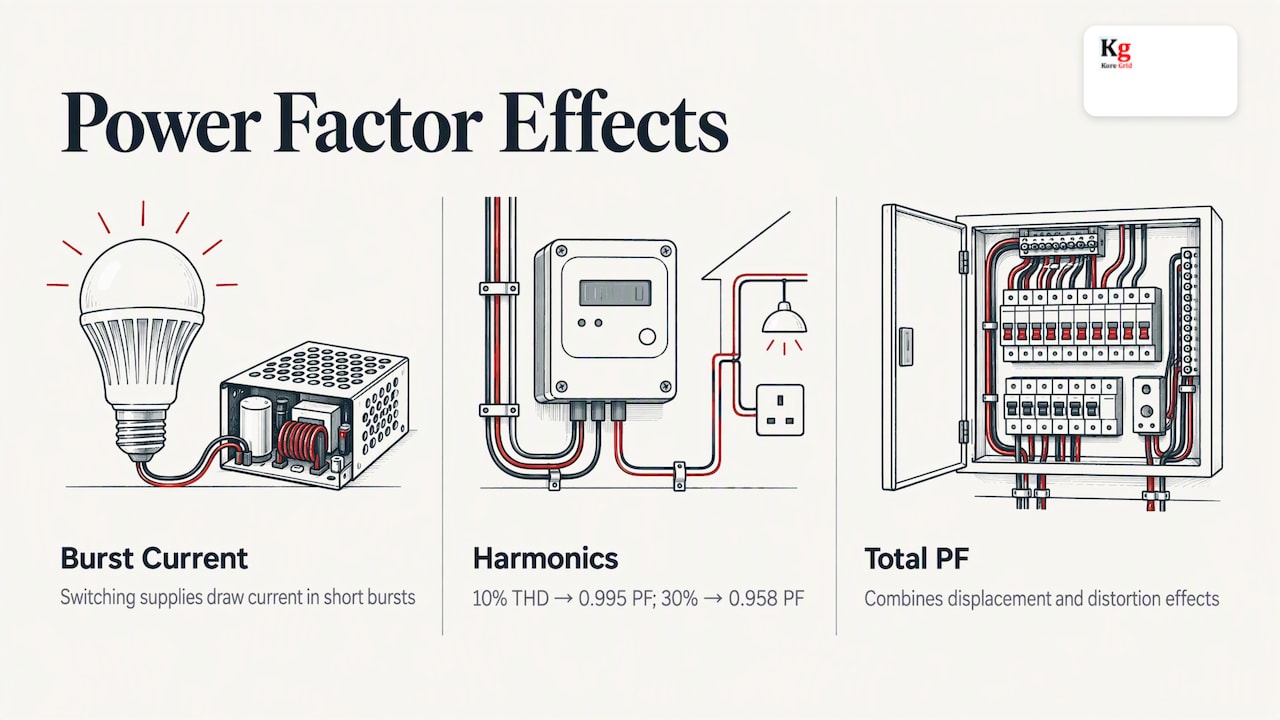
LED lights, TVs, computers, phone chargers, induction cooktops and smart appliances use switching power supplies. They draw current in short bursts rather than a smooth wave. That introduces harmonics, which are extra frequencies riding on the 50 Hz supply. This lowers what is called distortion power factor.
The Industrial Monitor Direct guide to harmonic limits points out that the simple formula (watts divided by VA) only applies cleanly to smooth sinusoidal waveforms. It also gives a worked example: at 10% total harmonic distortion the total power factor falls to about 0.995 even if displacement is perfect, and at 30% distortion it falls to 0.958.
Total power factor combines both effects. A technical paper on harmonics and power factor makes the case for using true power factor rather than displacement alone. A device can show a good displacement figure while still contributing harmonic distortion to your wiring.
If you remember one thing from this section: a modern home is not the same as a workshop full of motors. The fix that suits one may not suit the other.
What is happening on the New Zealand network
This is not only a household topic. The Electricity Authority held a workshop on reactive power flows and voltage coordination in February 2026. Its slides show that power factors at electricity distribution businesses have steadily improved, and are approaching unity. They also show that overnight they decrease into the leading region, raising concerns about managing overvoltage when demand is low.
That has a practical lesson for anyone adding correction equipment. Correction that is too strong, or not matched to the load, can push power factor past 1.0 into leading territory. More is not always better.
Lagging, leading and the 0.8 you keep seeing
Two more terms come up when you read about power factor:
- Lagging means current trails voltage. Motors and transformers cause this. It is the most common form.
- Leading means current runs ahead of voltage. Capacitors, or too much correction, cause this.
The figure 0.8 turns up a lot because generators are commonly rated at 0.8 lagging. Depco explains that the generating set industry settled on this rating because it lets a given set achieve its highest output rating for the smallest engine size. If you are sizing a generator, that is why its kVA and kW ratings differ.
How power factor gets corrected
The traditional method is to add capacitors, which supply the reactive power locally so it does not have to travel from the grid. Factories use banks of them. Small plug-in devices work on a similar principle at household scale.
This is where you should be a careful buyer. The Electricity Authority’s workshop material shows that residential power factor issues now often come from electronic loads rather than purely motor loads. A capacitor-based device that is not matched to the reactive load in your home can be ineffective, or can contribute to a leading power factor. Before buying any plug-in power factor product, ask:
- What load is it designed for? Motors, electronics, or a mix?
- Is it designed for harmonic-rich loads? This matters in a home with lots of LED and electronic equipment.
- What does the supplier actually claim? Look for specific, realistic wording rather than a headline percentage.
- Does it need an electrician? If a product connects into your switchboard, you need a registered electrician. A plug-in device is designed to avoid that.
- What is the return policy? Test results in a real home are the only proof that counts.
Our view: where a plug-in box fits
We make a plug-in Power-Saving Box for New Zealand homes, so you should know where we stand. This is how we think about power factor.
We do not tell people that power factor is a magic lever on the bill. Households pay for kWh, and a good article should say so. What we focus on is reducing electrical losses and improving power factor without rewiring, installation or major upgrades. That matters most for people who cannot or do not want to change their home:
- Renters cannot alter a switchboard or wiring. A device that plugs into a socket and moves with you when you leave is a practical fit.
- Older homeowners on tight budgets often want a simple step with no tradespeople, no disruption and no complicated setup.
- Anyone wanting to keep more of what they pay for while still doing the basics: efficient appliances, insulation, sensible heating.
Our honest advice is to start with the biggest wins first. Look at your high-consumption appliances, your heating habits and your fixed charges. Then treat a power-saving box as an efficiency helper alongside those steps, not a replacement for them. Savings differ by household, depending on what you run and how often. We would rather set realistic expectations than promise a number.
— Stan Lieder
A simple way to see your own power factor
You do not need to be an engineer to get a rough idea of where you stand.
- Look at the appliance label. Many appliances list watts and VA, or amps and volts. Watts divided by VA gives a rough power factor for that item.
- List your loads. Count motor-driven appliances (fridge, heat pump, washing machine, dishwasher, fans) and electronic loads (LED lights, TVs, computers, chargers).
- Ask your electrician. A registered electrician can measure true power factor at your switchboard with a power quality meter. This is the reliable way to know.
- Check your bill. Your bill will show kWh and fixed daily charges. If it shows no kVA line, you are on a standard domestic tariff and are not being billed for power factor.
- Compare before and after. If you add any correction device, note your usage over comparable periods, allowing for weather and occupancy.
Practical ways to use less power at home
Power factor is one part of home energy efficiency. These steps have a clear effect on the kWh part of your bill, which is the part you pay for.
- Run big appliances when you need them, not on standby.
- Check heating first. Heating is typically one of the largest household uses, and draught-proofing and insulation help every heater you own.
- Replace old, failing motors and appliances with efficient models when it makes sense.
- Switch off or unplug devices that sit on standby all day.
- Review your plan. The EA’s consumer site Powerswitch is not something we have used for this article, so ask your retailer about plan options and check the fixed daily charge, not just the unit rate.
Where our products fit
If you want a no-installation way to work on electrical losses and power factor, our Power-Saving Box plugs in without rewiring, which suits renters and anyone who wants a simple setup. We also offer portable energy storage with integrated solar charging in portable, trolley-mounted and modular stackable versions, for flexible backup and storage. You can see the range on our products page and request a quote online. Afterpay instalments are available at checkout if you prefer to spread the cost.
FAQ
What is power factor in simple terms?
It is the share of the power supplied to your home that does useful work. It is real power (kW) divided by apparent power (kVA), shown as a number from 0 to 1. A figure of 1.0 means nothing is wasted as reactive power.
What is a good power factor?
Closer to 1.0 is better. Many commercial sites aim for 0.95 or higher, because some utilities charge extra when it falls below 0.95. Households are not usually billed on this basis, so the target matters less for a home.
Will improving power factor lower my power bill in New Zealand?
Not directly for most households. Domestic bills are based on kWh used plus fixed charges. Improving power factor can reduce internal losses and equipment stress, but the dollar effect depends on your home. Ask your retailer or a registered electrician if you want advice on your own situation.
What is the difference between displacement and total power factor?
Displacement power factor only measures the phase shift between voltage and current, which motors cause. Total power factor adds the effect of harmonic distortion from electronics such as LED lights and chargers. In a modern home, total power factor is the more accurate measure.
Can a plug-in device make power factor worse?
It can if it is not matched to your loads. Capacitor-based devices can be ineffective with electronic loads or push power factor into the leading region. Ask the supplier which loads the device is designed for, and whether it suits harmonic-rich electronics.
Sources
- Reducing Power Factor Cost, US Department of Energy
- Power Factor Basics, IEA 4E
- How electricity works, Electricity Authority
- A quick guide to understanding your power bill, Billy
- Electricity (Low Fixed Charge Tariff Option for Domestic Consumers) Amendment Regulations 2021, NZ Legislation
- Electricity Price Review final report, MBIE
- IEC 61000-3-2 harmonic limits for power factor correction, Industrial Monitor Direct
- Motor Load (Linear), harmonics and power factor paper
- Reactive power flows and voltage coordination workshop, Electricity Authority
- Generator Power Factor: Definition, Formula & Sizing Guide, Depco
- Powerswitch
Leave a Reply