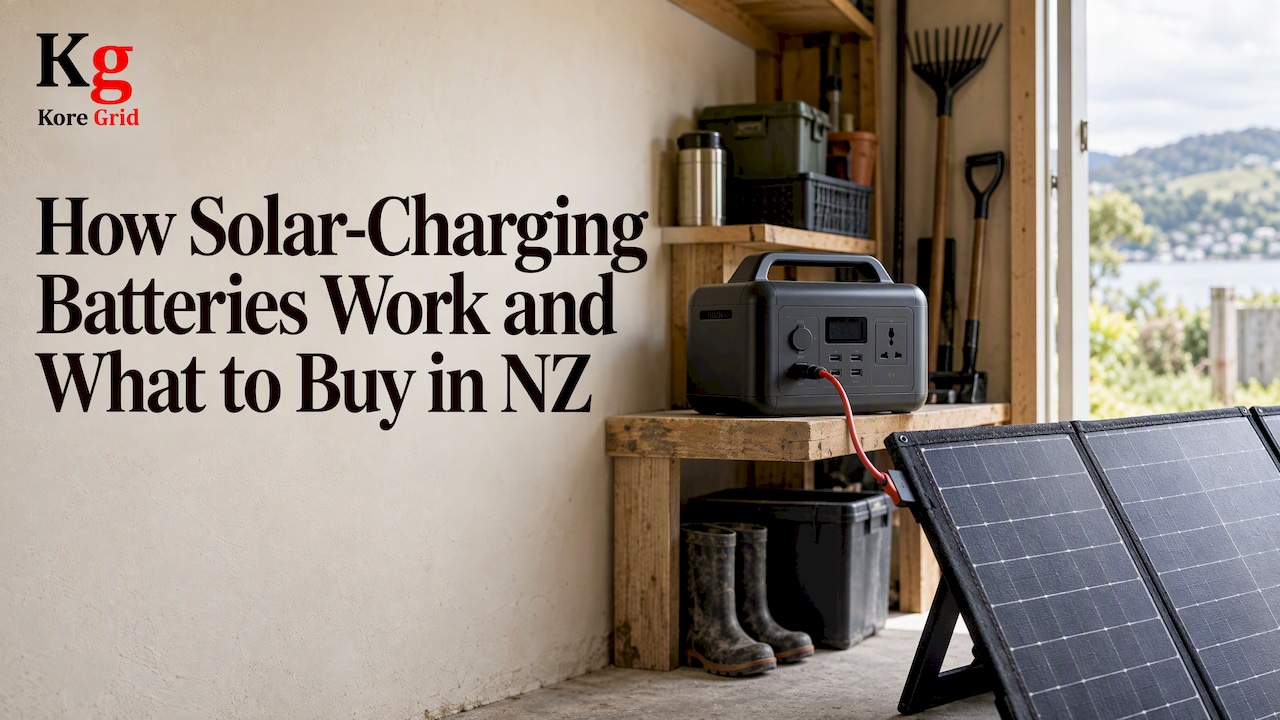
A solar charging battery is a battery you fill with power from a solar panel, then use later for lights, a fridge, a laptop or a router, even when the grid is down. In New Zealand, the simplest version is a portable battery unit with a solar input: you plug the panel in, leave it in the sun and draw power when you need it. No rewiring is needed. Larger systems that connect to your house wiring are a different matter and need a registered electrician.
This guide explains how solar charging works in plain language, how to size a panel and a battery, what real-world output looks like, and which safety checks matter before you buy.
TL;DR
- A portable solar battery stores power from a panel. It does not make power on demand, so judge it by battery capacity (Wh) and inverter output (W).
- Expect about half of a panel’s rated wattage in real conditions, so buy more panel than the label suggests.
- Lithium iron phosphate (LiFePO4) is the chemistry to look for: long cycle life and good thermal stability.
- Anything wired into your home’s electrics must be installed by a registered electrician. Plug-in units are the practical option for renters and anyone avoiding installation.
- Ask the supplier for a Supplier Declaration of Conformity (SDoC) before you buy any lithium battery.
Table of Contents
- What a solar charging battery actually is
- How solar charging works, step by step
- Real-world output: why 100W rarely means 100W
- Sizing: start with what you want to run
- Which battery chemistry to look for
- Portable, trolley or stackable: which format fits
- New Zealand rules and safety checks
- Our perspective: the cheapest kilowatt-hour is the one you don’t waste
- Where our products fit
- Practical tips for charging with the sun
- A quick buying checklist
- FAQ
- Sources
What a solar charging battery actually is
The name covers a few different things, and the keyword is searched in several ways: solar battery, portable solar battery, solar generator. They are not the same product.
- Home solar battery: a fixed battery that sits alongside rooftop panels and an inverter. It stores surplus daytime energy for the evening. The Electricity Authority says a battery lets you store excess energy for peak morning and evening periods, or for when the grid is unavailable.
- Portable solar battery unit: a self-contained box with a battery, an inverter and power outlets, plus an input for solar panels. People often call it a solar generator.
- Small trickle chargers: a 5W to 20W panel that keeps a car, caravan or boat battery topped up. Useful, but a different job.
The term “solar generator” is a bit misleading. As one buying guide points out, these are battery storage stations that accept solar input. They do not produce electricity on demand the way a petrol generator does. The sun fills the battery; the battery runs your appliances.
How solar charging works, step by step
- The panel turns sunlight into direct current (DC).
- A charge controller sits between panel and battery and manages how much power goes in. In a portable unit it is built in. The solar input is controlled by an internal MPPT charge controller, and a higher input rating means faster solar recharging.
- The battery stores the energy as chemical energy.
- The inverter converts stored DC power into 230V AC so you can plug in ordinary appliances.
The charge controller matters more than it sounds. Experts say MPPT controllers can squeeze 15 to 30 percent more power from your panels than older PWM types, especially in varied weather. That suits much of New Zealand, where cloud can roll in at any time of year.
Real-world output: why 100W rarely means 100W
The watt rating on a panel is a lab figure. Cloud, sun angle, dust and heat all pull it down. Manufacturers typically say you should expect around 50% of rated wattage in the real world, so the safe approach is to over-provision your panel capacity.
Here is a worked example using that 50% rule of thumb. The arithmetic is ours and ignores conversion losses, so treat it as a best case.
| Item | Figure |
|---|---|
| Panel rating | 200W |
| Realistic output (about 50%) | about 100W |
| Battery size | 1,000Wh |
| Hours of good sun to fill from empty | about 10 hours |
| Typical days to fill | 2 to 3 days of mixed weather |
If the same battery had only a 100W panel, you would be looking at about 20 hours of good sun. That is a long time in a Wellington winter. Doubling the panel is usually cheaper than waiting.
The same Consumer Reports page gives a useful anchor: charging a 10,000 mAh power bank from a 100W portable panel can take around 6 hours of direct sunlight under optimal conditions. Phones and power banks are easy. Running a household appliance is where sizing matters.
Sizing: start with what you want to run
Buyers often start with the panel. Start with the appliances instead.
Step 1: list your essentials
Write down each appliance and its power draw in watts. The label on the back, or the manual, will have it. Typical outage essentials are a router, phone chargers, a few LED lights, a laptop and perhaps a fridge. Our guide on how to cook without power in NZ covers the other big outage question.
Step 2: work out watt-hours
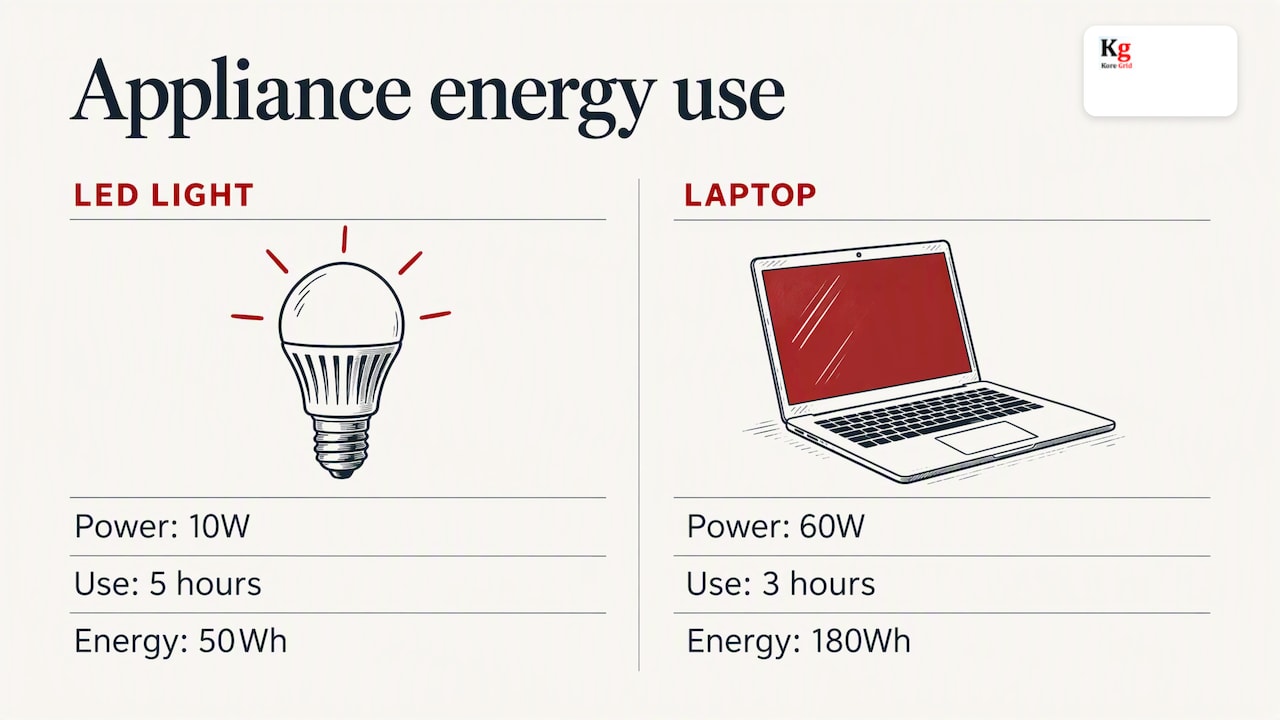
Multiply watts by the hours you want to run the appliance. A 10W LED light for 5 hours uses 50Wh. A laptop drawing 60W for 3 hours uses 180Wh.
Step 3: check the inverter
Battery capacity (Wh) is how long you can run things. Inverter output (W) is how much you can run at once. Buyers are advised to evaluate units on both, because a big battery with a small inverter still cannot start a power-hungry appliance. Appliances with motors or heating elements often need a higher surge rating than their running wattage.
Step 4: match the panel to the battery
Check the unit’s maximum solar input in watts and its voltage range. Two things to verify before buying are the input wattage and voltage compatibility of the panels you plan to use. Then apply the 50% rule to see how long a full recharge will take where you live.
Step 5: leave headroom
Buy a battery 20 to 30 percent larger than your calculation. Batteries age, winter days are short and outages never arrive at a convenient time.
Which battery chemistry to look for
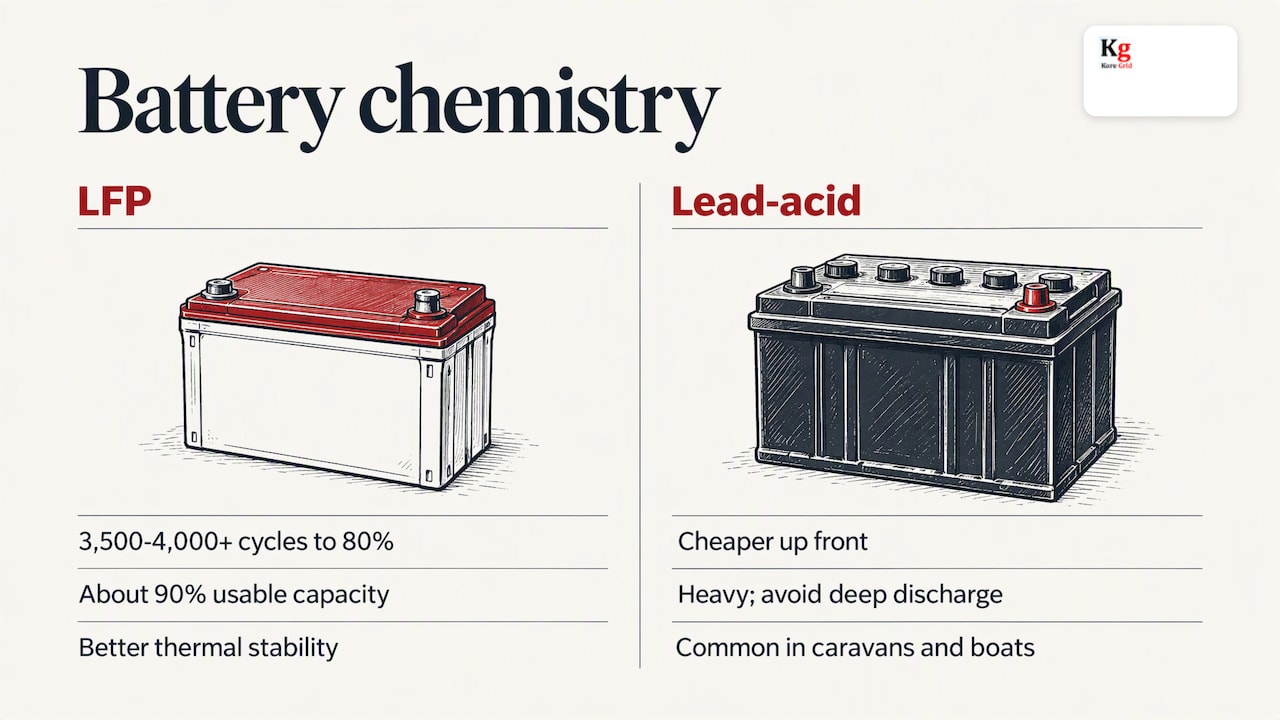
Most good portable units now use lithium iron phosphate, often written LiFePO4 or LFP. According to the same buying guide, LFP offers a cycle life of 3,500 to 4,000+ charges to 80% capacity, roughly 90% usable capacity, and better thermal stability than other lithium-ion types or lead-acid.
In plain terms, if you charge and use the battery once a day, thousands of cycles is many years of service. Lead-acid deep cycle batteries are cheaper up front and still common for caravans and boats, but they are heavy and you should not discharge them deeply. For a home backup or everyday power-saving setup, LFP is the sensible default.
Portable, trolley or stackable: which format fits
Because you are not wiring anything in, the choice comes down to how you live.
| Format | Best for | Watch out for |
|---|---|---|
| Portable unit | Renters, small flats, camping, a handful of essentials | Capacity limits what you can run |
| Trolley-mounted unit | Moving a heavier battery between rooms, the garage or the bach | Still needs sunny space for panels |
| Stackable modules | Households that want to start small and add capacity later | Plan the space and the charging input for extra modules |
All three can take solar input. The right pick depends on your appliance list from the sizing steps above, not on the biggest number on the box.
New Zealand rules and safety checks
This is where an informed buyer saves money and avoids risk.
Plug-in versus wired-in
Residential solar installation in New Zealand is regulated. WorkSafe recommends using a registered electrician to install PV systems. A self-contained unit that you plug an appliance into is a different category from a system connected to your switchboard. If you want backup power to feed your home’s fixed wiring, or you want a grid-connected system, talk to a registered electrician. We would never suggest a DIY connection to your house wiring.
If you rent, read our piece on solar for renters in New Zealand before you buy anything: it explains why checking 230V compatibility comes first.
Panels alone do not give you backup power
A common myth is that rooftop panels keep the lights on in a blackout. In most grid-tied systems the array shuts down when the grid fails, for safety. The Electricity Authority explains that keeping power in an outage generally takes a battery and the right system setup, configured by a professional for a fixed installation. A portable battery with its own inverter sidesteps this, because it is not connected to the network.
Lithium battery safety
WorkSafe’s guidance on safe use of lithium-ion batteries is worth reading in full. The points that matter for a solar battery buyer:
- Buy from a reputable supplier.
- Check that the instructions are in English and that any plug is a New Zealand type with insulated pins.
- Before buying a lithium-ion battery or charger, ask the supplier for a copy of the Supplier Declaration of Conformity (SDoC). WorkSafe’s advice is that if they cannot provide one, do not buy.
- Use the original charger, check for damage before charging, and keep batteries in cool, stable spots. Do not charge them under pillows or blankets.
If a battery swells, overheats or smells odd, stop using it and contact the supplier. For anything that looks like a fire risk, call 111.
Our perspective: the cheapest kilowatt-hour is the one you don’t waste
We work with New Zealand households that want lower power bills without a building project. Many are renters, and many are older homeowners on a tight budget. Their question is rarely “how do I go off-grid?” It is “what can I do this month that does not need a tradesperson or my landlord’s permission?”
Our view is that solar charging works best as one part of a bigger picture. The Electricity Authority notes that the financial benefit of solar lies in using the energy you produce on site rather than exporting it, because grid-purchased power includes transmission and distribution costs that typically make buy-back rates lower than what you pay. That is an argument for storing and using your own power, and it is also an argument for using less of the power you buy in the first place.
That is why we sell two kinds of products. Our Power-Saving Box is a plug-in device aimed at electrical losses and power factor, so you keep more of what you pay for. Our energy storage units, in portable, trolley and stackable formats, come with integrated solar charging for flexible backup and storage. They solve different problems, and we would rather you buy the one that fits your home than both by default.
We also want to be straight about limits. A portable unit will not run a whole house, and a cloudy week will slow your charging. Size it for the things that matter most to you, and treat it as backup and flexibility, not as a way to cancel your power bill.
— Stan Lieder
Where our products fit
If you want solar charging without installation, our energy storage range includes the All-in-One Portable ESS, the All-in-One ESS Trolley and the All-in-One Stackable ESS, each with integrated solar charging. Request a quote on the page and tell us which appliances you want to run: that is the quickest way to match a unit to your list. If you would rather cut your bill first, see how the Power-Saving Box works, or read the Power-Saving Box guide and our page on potential energy savings.
Practical tips for charging with the sun
- Face the panel at the sun. Tilt it towards the north in New Zealand, and move it through the day if you can.
- Keep it clear of shade. Even a small shadow across part of a panel can cut output sharply.
- Keep the panel clean. Dust and bird droppings cost you watts.
- Charge in daylight, not on a hot roof. Keep the battery itself in the shade, in a cool, stable place.
- Top up before storms. If a weather warning is out, charge the battery fully beforehand. Winter and cloudy spells make recharging slow.
- Have a backup charge route. Many units also charge from a wall socket, so you can fill them overnight when the grid is up.
- Use it regularly. Running your battery on everyday loads shows you real capacity and keeps you familiar with the controls before an emergency.
A quick buying checklist
- Capacity in Wh covers your appliance list plus headroom.
- Inverter output (W) and surge rating suit your biggest appliance.
- Battery chemistry is LiFePO4, with a stated cycle life.
- The solar input rating and voltage match the panels you will use.
- The charge controller is MPPT.
- The supplier provides an SDoC and a New Zealand plug.
- You know who supports it locally if something goes wrong.
Want more background on how power-saving fits in? Our Why Power Saving? page and the blog go further.
FAQ
How long does it take a solar panel to charge a battery?
Divide the battery’s watt-hours by the panel’s realistic output, which is about half its rated watts. A 1,000Wh battery with a 200W panel needs roughly 10 hours of good sun, so plan for two or three days in mixed weather. A bigger panel or a better MPPT controller shortens it.
Can a solar battery run my fridge in a blackout?
Often yes, if the battery and inverter are big enough, but check the fridge’s label for running and surge watts first. Add up the watt-hours for the hours you need and leave some headroom. For connecting a battery to your home’s fixed wiring, use a registered electrician.
Can I charge a solar battery without sun?
Yes. Most portable units also charge from a standard wall socket, so you can fill them from the grid overnight or before a storm. Solar then tops it up when the weather allows.
Do I need an electrician to install a portable solar battery?
A self-contained unit that you plug appliances into does not connect to your house wiring. Anything that connects to your wiring for backup or grid-tie operation needs a registered electrician, as WorkSafe recommends. If you are unsure which category your setup falls into, ask an electrician before you buy.
Sources
- Solar power | Electricity Authority
- DIY solar installations | WorkSafe
- Safe use of lithium-ion batteries and battery products | WorkSafe
- Solar Generator Buying Guide 2026
- Best Portable Solar Panels and Solar Battery Chargers | Consumer Reports
- How to Charge a Battery with a Solar Panel Effectively
Leave a Reply