Lights flicker for one of four reasons: the bulb or fitting, a dimmer that doesn’t suit LEDs, a wiring or connection fault, or a dip in voltage. The voltage dip can come from a big appliance starting up in your home, or from the network outside it. The first two are usually cheap to fix. The third can be a fire risk. The fourth is often normal, but not always.
This guide helps you tell them apart. It also covers what “sag and swell” means in plain language, why lights dim when a heat pump or vacuum starts, and which jobs are legally for a licensed electrician in New Zealand.
TL;DR
- Flicker in one light only usually points to the bulb, the fitting or a dimmer. Flicker in several rooms points to the circuit, the switchboard or the supply.
- A brief dim for a second when a heat pump, oven or vacuum starts is often normal. Dimming that is frequent, severe, or comes with buzzing, heat or a burning smell is not. Switch off the circuit and call a licensed electrician.
- If your neighbours see the same flicker, report it to your lines company before paying for an electrician.
- Fixing wiring is not a DIY job in New Zealand. Changing a bulb or an LED-compatible dimmer is far simpler, but check the rules first.
- A plug-in power-saving box does not repair faulty wiring. It is aimed at reducing electrical losses and improving power factor, which is a different problem from a loose connection.
Table of Contents
- Start with how the flicker behaves
- Cause 1: the bulb or the fitting
- Cause 2: dimmers that don’t suit LEDs
- Cause 3: loose connections and ageing wiring
- Cause 4: big appliances starting up
- What “sag and swell” actually means
- Cause 5: the network outside your house
- What you can and can’t do yourself in New Zealand
- A step-by-step way to find the cause
- Our perspective: efficiency is not the same as a fix
- Where a power-saving box fits
- Practical tips to reduce flicker and dips
- FAQ
- Sources
Start with how the flicker behaves
Before you look at a single bulb, notice the pattern. The pattern narrows the cause faster than any tool.
| What you see | Most likely cause | First step |
|---|---|---|
| One bulb flickers, others fine | Loose bulb, failing LED, worn fitting | Switch off, let it cool, re-seat or replace the bulb |
| Flicker only on a dimmer circuit | Dimmer not matched to LEDs | Check the dimmer and bulb ratings |
| Lights dim for a second when an appliance starts | Start-up (inrush) current | Note which appliance, and how long the dip lasts |
| Flicker in many rooms, at random | Loose connection at the switchboard, or supply issue | Ask neighbours, then call your lines company or an electrician |
| Flicker plus buzzing, warm switches or burning smell | Possible loose connection or overheating | Turn off the circuit and call a licensed electrician now |
Write down when it happens. “Every evening around 6 pm” and “only when the heat pump kicks in” are the kind of details an electrician can act on.
Cause 1: the bulb or the fitting
The simplest explanation is often the right one. A bulb that isn’t seated properly can flicker, and so can an older or poor-quality LED. Worn fittings add to the problem. One electrical guide from an electrical contractor makes the same point: check the basics before assuming a wiring fault.
A New Zealand electrical firm in Hawke’s Bay, Alba Electrical, lists failing lamp holders as a common problem in older NZ homes. Tapping the fitting makes the light blink, or you hear crackling. That is a sign to stop and get it checked, not to keep tapping.
What you can safely try:
- Switch the light off at the wall and wait for the bulb to cool.
- Remove the bulb and refit it firmly, or swap in a bulb you know works.
- If the new bulb flickers in the same fitting, the fitting is the suspect. Leave it to an electrician.
Cheap LED bulbs deserve a mention. Their small internal driver circuits vary a lot in quality, and flicker is one way a poor one shows itself. If one brand of bulb flickers in several fittings in your house, stop buying that brand.
Cause 2: dimmers that don’t suit LEDs
If the flicker only appears when the lights are dimmed, look at the dimmer. Older dimmers were designed for incandescent bulbs, which draw plenty of power. LEDs draw very little, and a dimmer built for the old loads can’t regulate that small current cleanly. The result is strobing or buzzing. Homebuilding’s lighting advice describes this mismatch and says that an LED-compatible dimmer is often a simple, low-cost fix.
The Canadian Centre for Occupational Health and Safety also lists incompatible dimmers with LED or fluorescent bulbs among the common residential causes.
What to check:
- Is the bulb labelled “dimmable”? Many LEDs are not.
- Does the dimmer have a minimum load rating that your bulbs fall below? One or two low-wattage LEDs on a dimmer rated for a much larger load is a classic mismatch.
- Do you have a mix of different bulb types on the one dimmer? Try matching them.
Swapping a dimmer means working on fixed wiring, so read the legal section below before you pick up a screwdriver.
Cause 3: loose connections and ageing wiring
This is the cause to take seriously. A loose connection in a switch, a power outlet, a light fitting or the switchboard can make lights flicker at random. It can also create heat and arcing.
An electrician-written guide is blunt about it: frequent or severe dimming, especially with heat, buzzing or burning smells, is a red flag. It says loose connections in the panel or outlets carry a significant fire risk and should be dealt with by a professional straight away, not by the homeowner.
Warning signs that go with flicker:
- A switch or power point that feels warm
- A buzzing, crackling or sizzling sound from a wall or fitting
- A burning or hot-plastic smell
- Discolouration around an outlet
- A circuit breaker that trips repeatedly
If you notice any of these, turn the circuit off at the switchboard and call a licensed electrician. If you see smoke or flames, call 111.
Older homes are more likely to have this kind of problem, simply because connections have had decades of heating, cooling and vibration. Renters should tell the landlord or property manager in writing, so the repair is on record.
Cause 4: big appliances starting up
This is the cause behind the second thing people search for: lights dimming at startup.
Motors and compressors pull much more current when they start than when they run. Allstar Electrical calls this inrush current. For a moment, the voltage across the rest of your circuits drops, and the lights dim in step. Heat pumps, fridges, washing machines, vacuum cleaners, power tools and pumps all do it.
In most homes, a brief dip for a second or so as a large appliance starts is within normal limits, according to the Ask Sparky guide. It matters more when:
- The dimming is deep, long or happens every time
- It got worse recently, with no new appliance
- Other things misbehave at the same time, such as a TV or computer rebooting
- You notice heat, buzzing or smells
One DIY forum answer pointed out something worth knowing even if the dimming is harmless: sensitive electronics on the same circuit experience the same dip the lights do. That is a good reason not to ignore repeated dips.
What helps
The fix depends on the cause. Allstar Electrical notes that variable-speed appliances ramp up gently instead of snapping on at full power, which cuts the inrush. For severe cases, a licensed electrician may suggest dedicated circuits for the heavy appliances.
If the heat pump is the culprit, our heat pump efficiency tips cover how to run it well on a New Zealand winter bill.
What “sag and swell” actually means
Electricians and engineers use two terms for voltage movements, and they show up in search results without much explanation.
- Sag (or dip): voltage drops below normal for a short time. IEEE 1159, as summarised by SagSwell, defines it as a reduction to between 0.1 and 0.9 of nominal voltage, lasting from half a cycle up to one minute. Motor start-up is a classic trigger.
- Swell: voltage rises above normal, above 1.1 of nominal in that definition. It can happen when a large load switches off.
Both make lights dim or brighten. If the movements are small and short, you may never notice them. If they are bigger, lights in several rooms change together because the rooms share a circuit.
The standard is an international one, so treat the exact percentages as a reference rather than a New Zealand rule for your home. What matters for you is the pattern: dips tied to one appliance suggest a local cause, and dips at random times suggest something upstream.
Cause 5: the network outside your house
Sometimes the problem isn’t yours. If your neighbours also see lights flicker or dim, it’s more likely a network-side event. That’s useful to know before you pay for a callout.
New Zealand’s grid is small compared with those overseas. The Electricity Authority’s frequency consultation paper says that more wind and solar generation is likely to cause more variability in frequency within the normal band of 49.8 to 50.2 Hz. Frequency movement within that band is not what usually makes a bulb flicker at home, and no household needs to worry about it. It does show that power quality is a live topic as the grid changes.
In practice, the reason for local flicker is more likely to be a local line fault, a loose connection on the service line, or a heavy load nearby. Lines companies take these reports. For example, Wellington Electricity lists dim, glowing or flickering lights, and fluctuating voltage, as something to report. Your own lines company will have a similar page. Check your power bill to see who it is.
What to tell them:
- Your address and how long it has been happening
- Whether it’s one room, the whole house or the street
- Whether it happens at certain times of day
- Any other symptoms, such as a tingle from a metal object (report this as a hazard straight away)
What you can and can’t do yourself in New Zealand
The rules matter here, because the temptation to fix a flickering fitting yourself is strong.
According to WorkSafe New Zealand, homeowners may do only a limited range of electrical work, and some of it must be inspected and tested by a licensed person who then connects it. WorkSafe warns that electrical work can kill if you don’t have the skills and knowledge to do it safely and legally. It has also warned homeowners after a fatal accident involving wrongly wired light fittings.
In plain terms:
- Swapping a light bulb is fine.
- Anything that involves altering fixed wiring, switches, dimmers, or the switchboard is a job for a licensed electrician unless WorkSafe’s page clearly says you may do it.
- If you rent, don’t touch fixed wiring at all. Report it to the landlord.
When in doubt, ask. A short call to an electrician costs far less than a fire.
A step-by-step way to find the cause
- Map it. Which lights flicker? One, one room, or the whole house?
- Time it. Does it happen at a set time, or only when a particular appliance starts?
- Swap the bulb. Try a known-good bulb, ideally a dimmable LED if the circuit is dimmed.
- Check the dimmer. If flicker happens only when dimmed, the dimmer and bulb are probably mismatched.
- Look and listen. Warm switches, buzzing or smells mean stop and call an electrician.
- Ask the neighbours. If they flicker too, contact your lines company.
- Book an electrician if flicker is frequent, spread across rooms, or you can’t trace it.
This order puts the free and safe steps first. It also keeps you from paying for a callout that the lines company would have covered.
Our perspective: efficiency is not the same as a fix
We sell plug-in equipment for New Zealand homes, so people sometimes ask whether our Power-Saving Box cures flickering lights. We want to answer that honestly.
It doesn’t repair a loose connection, a bad dimmer or a failing bulb, and nothing plug-in can. If your lights flicker with buzzing or heat, you need a licensed electrician, not a gadget. We’d rather you got that right than bought something that doesn’t fit the problem.
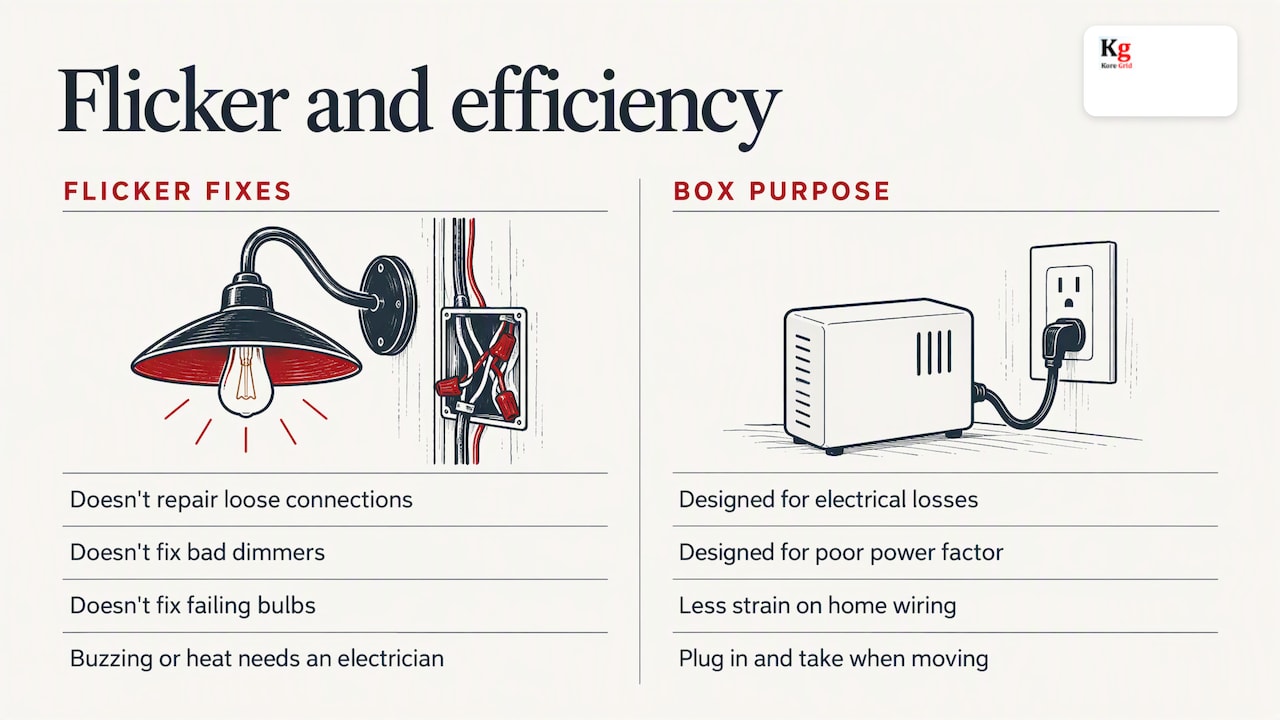
What the box is designed for is a different, quieter problem: electrical losses and poor power factor in a home. Our power factor explainer covers it in plain language. A home that wastes less of what it draws puts less strain on its own wiring and connection. As the Electricity Authority’s work shows, the grid is changing, and efficiency at the household end is a sensible thing to improve either way.
Our approach is built around people who can’t or don’t want to rewire. Renters can’t alter a landlord’s switchboard, and many older homeowners don’t want building work. A box you plug in, and take with you when you move, suits both. Read our Power-Saving Box guide for how it works and what to expect.
— Stan Lieder
Where a power-saving box fits
If you’ve ruled out faults, or an electrician has confirmed that your wiring is sound, the next question is the bill. The Power-Saving Box plugs into a standard outlet and needs no installation. It is designed to reduce electrical losses and improve power factor. You can see how it works on our Power-Saving Box page, and what households might save on our potential savings page.
If your concern is outages and backup rather than flicker, we also offer portable, trolley and stackable battery systems with solar charging. They are on our energy storage products page. Prices are not published, so you request a quote through the site, and Afterpay instalments are available.
If you’re a renter looking at solar, check our note on 230V and solar for renters first.
Practical tips to reduce flicker and dips
- Match bulbs to dimmers. Buy dimmable LEDs for dimmed circuits, and check the dimmer’s minimum load.
- Spread heavy loads. Avoid starting the oven, dryer and heat pump at the same moment if you notice a dip.
- Don’t run sensitive electronics on a circuit that dips. Use a different power point for a computer or a home office.
- Replace old fittings. Have an electrician swap fittings that crackle or loosen.
- Keep a log. Dates, times and the appliance involved make a fault far quicker to find.
- Report network issues. If the whole street flickers, tell the lines company.
FAQ
What causes lights to flicker in the house?
The common causes are a loose or poor-quality bulb, a dimmer that doesn’t suit LEDs, loose wiring, large appliances drawing a burst of current as they start, and voltage problems on the network. One flickering light usually points to the bulb or fitting. Several rooms point to the circuit or the supply.
Do LED bulbs flicker?
They can. Cheap bulbs with weak internal drivers are a common culprit, and so is pairing a non-dimmable LED with a dimmer. Try a different bulb in the same fitting. If it stops, the first bulb was at fault. If it continues only on a dimmer, the dimmer is a better suspect.
Is it normal for lights to dim when the heat pump starts?
A brief dip for a second as a large motor starts is often normal, because of inrush current. It is not normal if it is deep, frequent, getting worse, or comes with buzzing, heat or a burning smell. In that case, switch off the circuit and call a licensed electrician.
Can I fix flickering lights myself in New Zealand?
You can replace a bulb. Work on fixed wiring, switches, dimmers or the switchboard is restricted, and WorkSafe says some of it must be done or checked by a licensed person. Renters should report faults to the landlord rather than attempting repairs.
Should I call the power company or an electrician first?
Ask your neighbours first. If they see the same flicker, call your lines company, which handles network faults. If only your house is affected, or you notice heat, buzzing or smells, call a licensed electrician.
Sources
- Canadian Centre for Occupational Health and Safety: light flicker
- SagSwell: voltage sag and swell under IEEE 1159
- Allstar Electrical: steps to prevent lights dimming
- Ask Sparky: why lights dim when appliances turn on
- Homebuilding: flickering lights in the house
- Alba Electrical: why lights flicker in NZ homes
- DIY Stack Exchange: window AC and dimming lights
- Electricity Authority: frequency-related Code amendment proposals
- Wellington Electricity: report a power problem
- WorkSafe NZ: doing your own electrical work
- WorkSafe NZ: installing your own light fittings
Leave a Reply